UXDE dot Net

Digging for Gold: The Time-Life “AM Gold” Series, Part 30

By -

Hardcore fans of the Guess Who and Three Dog Night probably have no problem distinguishing the two bands, but as this week’s look at AM Gold: 1969 shows, that doesn’t apply to everyone. One thing is certain, though. There was only one Harry Nilsson.

(Spotify users, you can subscribe to our Best of AM Gold playlist, which is updated regularly.)


The Guess Who, "These Eyes"#6: The Guess Who, “These Eyes” – #6 U.S.

Dw. Dunphy - I always had difficulty keeping The Guess Who from being mixed up with Three Dog Night. Strange, no? There are so many other bands that they could be lumped with (The plain old Who, for instance), but no. There is a total similarity between the Burton Cummings fronted Guess Who and the Cummingsless Three Dog Night. And so it goes.

I like “These Eyes” much more than “American Woman” but not as much as “Undun.” I think I know why too. “These Eyes” hums along quite well until that bridge portion with “TheseEyesThey’veseenalottalovebuttheynevergonnaseeanotheronelikeIhadwithyouuuuuu…” which sounds kind of ridiculous in retrospect. The fadeout with that same mashed-up mess suffers even more because Cummings tries to make it soulful. It doesn’t work. This is a song that could have been so much better with that subtraction. As is, I just rollalottaeyeswhenthatpartcomesalongohyeaaaahhhhh… 

Jon Cummings - For a decade now, a mention of the Guess Who calls to mind Phillip Seymour Hoffman ranting as Lester Bangs in Almost Famous: “Give me the Guess Who! They’ve got the courage to be drunken buffoons, which makes them poetic!” I see Dw.’s point about that point in the bridge on “These Eyes,” though I don’t have a problem with that particular run-on phrase. For me, the critical demerit in the GW’s ouevre is the fade-out from “Laughing,” on which my brother-from-a-similarly-last-named-mother actually does the “ha-ha-ha-ha, ha-ha” bit. Ridiculous! My default setting on the Guess Who, from childhood, has always been that I wanted to hear them (and they wanted to be heard) as a “rock” band, but I couldn’t do it, usually because of some lyrical imagery or Burton-sung silliness that nudged them back into mere “pop” territory. Not that there’s anything wrong with that.

Chris Holmes - The Guess Who were at their best when they let some jazz influence shine through. Listen to “Undun” or the chorus on “When Friends Fall Out.” 100% win.

Dunphy - ”Undun” is the classic for me, no question about it. One other thing about “These Eyes” is that it constantly gets jumbled with “You Make Me So Very Happy” (from Blood, Sweat and Tears) in my head.

David Lifton - I don’t think it’s strange to confuse The Guess Who and Three Dog Night. Throw BTO and Grand Funk in there and you have the era’s equivalent of what Candlebox and Collective Soul were to the mid-90s, competent, if watered down, takes on the dominant sound of the day. If “These Eyes” and “Undun” hold up better than their contemporaries’ material (or Candlebox, for that matter. Can we call them “AM Grunge?”), it’s because of Burton Cummings’ voice. If it falls short it’s because of the repetition of the lyric, not because of the performance.

Jack Feerick – I heard this opening riff the other day, sampled, on a Girl Talk record, and I couldn’t quite place it. Which says it all, I suppose.

This is lesser Guess Who, with all that implies. It doesn’t help that Burton’s white-blooze howl is ill-suited for the material, and no amount of Bacharach-style horns can conceal it.
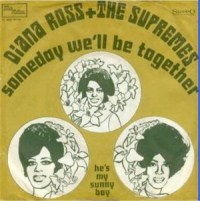

Diana Ross & The Supremes, "Someday We'll Be Together"#7: Diana Ross & The Supremes, “Someday We’ll Be Together” – #1 U.S., #13 U.K.; the group’s last #1 single.

Dunphy - Would this be considered the Supremes’ last great single? Might be, and although Miss Diana’s all over it, it is that hook of “Someday — we’ll be together” that I always hear when I think of it. I may be excessively harsh toward Diana, recalling the inordinate amount of power she possessed in Motown, but it has to be said. She probably would have been a star regardless of the favorable gerrymandering that occurred in her favor.

It also has to be said that, even though the Supremes as a unit was this interchangeable conglomeration based mostly on whims, it was always awesome. So sad that they always were shown up instead of celebrated in a more democratic fashion.

Cummings - It’s ironic that you talk about the “awesome”ness of the Supremes’ performances as a group, because while “Someday We’ll Be Together” certainly sounds like more of a group effort than the previous three years (at least) of the group’s work, the other Supes (Cindy Birdsong and Mary Wilson) aren’t even on it! It was intended to be Diana’s coming-out single as a solo, but then was pulled back into the Supremes context, seemingly calculated to document Diana’s departure from the group and to put a nice, Motown-y gloss on the event. I’ve never been able to hear the single outside that context, though it’s certainly pleasant enough — more a vamp than a song, really, the same way Diana would record “Ain’t No Mountain High Enough” more as a riff on the song than as the song itself.

Lifton - It’s amazing to hear all these Supremes songs chronologically, because you see how Diana became a bigger star by putting increasingly less effort into her performances. The voice is the same, but she hardly sounds like the girl who sang “You Can’t Hurry Love” or “Back In My Arms Again.” By this time it was mostly spoken sections or empty cooing, as she does here.

Feerick – Exactly. Miss Ross is now The Name Above The Title, and will no longer deign to break a sweat or get her hair mussed. By which I mean, she’s just no fun anymore.


Classics IV, "Traces"#8: Classics IV, “Traces” – #2 U.S.

Cummings - A sweet song, innit? Certainly a continuation of their shift toward AC, following the success of their previous single, ”Stormy.” (They rocked a bit more on their first big hit, ”Spooky.” Maybe their subsequent name change, to “Classics IV featuring Dennis Yost,” was intended to signal an increasing emphasis on ballads and Yost’s swoony vocals.) Anyway, I mentioned while discussing “Spooky” a few weeks ago that the Classics IV’s songwriters went on to serve as the backbone for the Atlanta Rhythm Section; knowing that, it’s impossible to hear ”Traces” without noticing their affection for chord triplets, which also weave through “Spooky” and, later, “Imaginary Lover.” As long as I’m talking about mental associations, I’ve never been able to hear ”Traces” without segueing in my head into the Carpenters’ “For All We Know,” because the melody line as Yost sings “Traces of love, long ago” is a minor-key transposition of the point in latter song when Karen sings, “We’ve got a lifetime to share.” (Actually, I suppose the inverse is true, since “Traces” came a year earlier.)

Dunphy - Huh! You’re absolutely right on that one, Jon. I couldn’t hear the song in my head until the moment you mentioned that line from “For All We Know.” Then, bam, there it is.

This is probably the second favorite Classics IV track of mine; the first being “Stormy.” This one however is pure schmaltz and schmooze, but in a good way and sentimental to the bone.

Lifton - A pretty song I’ve never really given a second thought to, or even realized who sang it. Who knew that Classics IV had so many decent hits? To me they were always the band whose dusty Greatest Hits cassette I’d always see when deciding which Clash album to buy next.

Feerick - Why oh why do people insist on rewriting “These Foolish Things” over and over? “Traces” isn’t a bad song, but there’s really no compelling reason for it to exist.
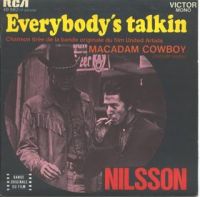

Nilsson, "Everybody's Talkin'"#9: Nilsson, “Everybody’s Talkin’” – #6 U.S., #23 U.K.

Dunphy - Perhaps his most famous song, I’ve always liked it but after experiencing so much more of Nilsson’s work, it just doesn’t match some of his very best. I know, it’s not “his” song because he covered someone else (but the same could be said for “Without You”) and so I have to expect certain behavioral variations, but even so. In a room with “Without You,” “One,” “Jump In The Fire,” and a few others, this is a lovely tune that flows in and out. If it sounds like some kinda lunacy that I would diminish the song in any way, ah well. I’m a rebel.

Cummings - I love this record. But I love it even more in its alternate form, as “I Guess the Lord Must Be in New York City.” The two singles are so similar in structure and arrangement that one must wonder at the series of events that led to their joint existence. ”Everybody’s Talkin’” was written by Fred Neil in 1966, but his original recording  has a straight-up country arrangement. Did Nilsson record his version of it first, as requested by the producers of Midnight Cowboy, then think to himself, “I can do better, and get some BMI royalties to boot!” Or did he write ”IGtLMBiNYC” first, only to be told, “This sounds a lot like ‘Everybody’s Talkin’,’ so why don’t you just record that instead?” In any case, “Everybody’s Talkin’” made it into the film, to the enormous benefit of everyone involved — would the film, which is unbelievably great on its own, have won the Oscar if not for the song? And “IGtLMBiNYC” made it into You’ve Got Mail 30 years later, so Nilsson got some bonus soundtrack checks out of BMI after all. Too bad he was dead at the time.

Lifton - Just take whatever the Hell I wrote about “Wichita Lineman” a few weeks ago and apply it here.

Feerick - You know, there are a bunch of individual Harry Nilsson songs that I like, but I could never call myself a fan, because I find it hard to get a handle on him as an artist, because he’s so all over the map. “Jump Into the Fire” and “Coconut” hardly sound like the work of the same man, and neither of them sounds a bit like “Everybody’s Talkin’”, which makes it hard to point to one representative track and say, “I would like more like this, please” — with Nilsson, there is no one representative track; everything is a one-off.

Holmes – My thoughts on Nilsson exactly. He’s one of those artists I feel like I should love as a music fan, but I’ve never been able to make it happen.

Jeff Giles - Nilsson’s eclecticism has always been a real selling point for me. His music is a perfectly boozy balance of the sacred and the profane — you never knew whether he was going to crack a dirty joke or break your heart.

Feerick – Well, sure. He was such an exquisitely sensitive singer, and that’s why his sound was all over the place — he pitched every performance to the demands of the individual song. Here he captures a weary vulnerability, and it works beautifully, for the most part.

The “wahh-wahhhhh-wah” bits, though, I still find jarring and inexplicable. Unless that’s the sound of everybody talkin’ at him, rendered Charlie Brown-style?


Three Dog Night, "Easy to Be Hard"#10: Three Dog Night, “Easy to Be Hard” – #4 U.S.

Dunphy - I recall when I was in either first or second grade, in St. Mary’s Parochial School, there was a kid that really liked Three Dog Night only didn’t know it. He’d always say he liked “Jeremiah Was A Bullfrog!” I had no idea what he was talking about until later, realizing he was speaking of the song “Joy To The World.” I suppose I was precocious in the fact that I knew the distinction at that age, but by now you should know how much of a music nerd I am, and this stuff just don’t happen overnight.

So I had the song right, but not necessarily the band. Owing to what I said earlier, I kept mixing Three Dog Night and The Guess Who together in my youth. I absolve myself of any guilty feelings about is because, I believe, this is an easy mistake. We have two mid-range pop-rock outfits that really wanted to be heavy rockers. Sometimes it fit, and sometimes it didn’t.

Just as The Guess Who had “Laughing,” “Undun,” and the very different “American Woman,” so too you had “Joy To The World,” “Liar,” and “Easy To Be Hard” which is, essentially, adult contemporary. The key difference is that the Guess Who’s songs were mostly by them where Three Dog Night mostly had hits with covers. “Easy To Be Hard” is from the score of Hair, “Liar” is from Argent, Hoyt Axton wrote “Joy To The World” and so on. They scored big with a cover of Nilsson’s “One,” making it the version people know best and, also, making this edition of AM Gold one of the most inbred messes ever. In a way, Three Dog Night is more like Vanilla Fudge conceptually.

Musically though, they were intrinsically a part of their time. There are some bands that go on in perpetuity (Stones, Beatles in a way, there are others) and others that have to end. Both The Guess Who and Three Dog Night were in that mix.

Holmes - Some time over the summer I got into a huge Guess Who phase. I don’t know how it happened, but I think I actually listened to the entire American Woman album and fell in love. That run of albums from Wheatfield Soul through Share the Land has some great, great music.

Cummings - When I was in high school — this would be about 1982 — a friend of mine came to school one day with his collection of Three Dog Night LPs to lend to another friend. During lunch I mercilessly ridiculed the notion of owning actual Three Dog Night albums, as well as the concept of being an actual FAN of the group. I didn’t analyze the source of my shaming at the time, but I think it had to do with the fact that they didn’t write their own hits, as well as with the stylistic diversity of those hits, which veritably screamed “singles band.” Most of all, though — as someone who began listening to the radio just after 3DN’s run of hits ended, and first experienced almost all of them as “oldies” — I just didn’t see them as a group with enough charisma or even identity to instill devotion, rather than appreciation for individual singles. That said, a lot of their singles were terrific. “Easy to Be Hard” isn’t as great as some others, but all these years later it has a valuable message even outside the context of Hair-mania (which it rode into the Top 5) – and that message is, just because you’re a bleeding-heart liberal doesn’t mean you’re not a dick. A sobering thought for some of us…

Lifton - I’ve already expressed my overall negative reaction to Hair, so instead I’ll simply point out that Chuck Negron looks an awful lot like Derek Smalls in that clip.

Feerick - Uhhhhhhh-huh-huh. Heh. Heh heh. Uh-huh-huh-huh-huh. He said “hard.” Heh. Uh-huh-huh.

Enhanced by Zemanta

Some days won't end ever, and some days pass on by. We'll be working here forever, at least until we die. Working for a living. Living and working. Taking what they're giving 'cause we're working for a living.

  • Egebamyasi

    The first few Guess Who hits are pop genius and the parts that make you cringe are the parts that get stuck in your head and you can’t help but singing those stupid parts out loud. HAHAHAHAHAHA!
    Check out this alternate version By Burton Cummings: http://youtu.be/bhitnFRHBck

  • mark

    My rule of thumb has always been “If you hear a song that’s clearly from the ’70s, has a basic four piece rock arrangement, is mid-tempo, and is *pretty good* but not really mindblowing, chances are it’s Three Dog Night.” 

    The Guess Who, on the other hand, are underrated IMHO as a band with some actually interesting album tracks and quite a sense of humor.  Really all their albums between 1968 and 1973 are fun, and perhaps the “American Woman” and “Share the Land” albums have the best music on them overall, but a favorite of mine for a while has been 1971′s “So Long Bannatyne,” which contains only two minor hits (Rain Dance and Sour Suite) but has some eclecticism that has to be heard to be believed.

  • citizenblaine

    “These Eyes”:  Unlistenable smarm.  A good example of why talent doesn’t matter as much as attitude in rock and roll.  Randy Bachman, who can’t sing his way out of a paper bag, sounds so much better than this on “You Ain’t Seen Nothin’ Yet,” a real rock song.
    “Someday We’ll Be Together”: It’s the soul guitar and the string part that make this song work.  Dianna isn’t trying to sell it like the early hits, but that works too.  She sounds totally confident and relaxed – an unusual vibe for her.
    “Traces”: Unlistenable smarm, period.  Why even bother talking about it?
    “Everybody’s Talkin’”:  Barely listenable smarm, and only for the lines, “Goin’ where the weather suits my clothes…Skippin’ over the ocean like a stone.”  The verses are very close to “Elusive Butterfly” territory.  Is there a category of “sailor-songwriters?”  Fred Neil, David Crosby, that Margaritaville guy, who else?
    “Easy To Be Hard”: Utterly unlistenable smarm.  It must be Smarm Week on AM Gold when the only listenable voice is Miss Di.

  • citizenblaine

    “These Eyes”:  Unlistenable smarm.  A good example of why talent doesn’t matter as much as attitude in rock and roll.  Randy Bachman, who can’t sing his way out of a paper bag, sounds so much better than this on “You Ain’t Seen Nothin’ Yet,” a real rock song.
    “Someday We’ll Be Together”: It’s the soul guitar and the string part that make this song work.  Dianna isn’t trying to sell it like the early hits, but that works too.  She sounds totally confident and relaxed – an unusual vibe for her.
    “Traces”: Unlistenable smarm, period.  Why even bother talking about it?
    “Everybody’s Talkin’”:  Barely listenable smarm, and only for the lines, “Goin’ where the weather suits my clothes…Skippin’ over the ocean like a stone.”  The verses are very close to “Elusive Butterfly” territory.  Is there a category of “sailor-songwriters?”  Fred Neil, David Crosby, that Margaritaville guy, who else?
    “Easy To Be Hard”: Utterly unlistenable smarm.  It must be Smarm Week on AM Gold when the only listenable voice is Miss Di.

  • citizenblaine

    “These Eyes”:  Unlistenable smarm.  A good example of why talent doesn’t matter as much as attitude in rock and roll.  Randy Bachman, who can’t sing his way out of a paper bag, sounds so much better than this on “You Ain’t Seen Nothin’ Yet,” a real rock song.
    “Someday We’ll Be Together”: It’s the soul guitar and the string part that make this song work.  Dianna isn’t trying to sell it like the early hits, but that works too.  She sounds totally confident and relaxed – an unusual vibe for her.
    “Traces”: Unlistenable smarm, period.  Why even bother talking about it?
    “Everybody’s Talkin’”:  Barely listenable smarm, and only for the lines, “Goin’ where the weather suits my clothes…Skippin’ over the ocean like a stone.”  The verses are very close to “Elusive Butterfly” territory.  Is there a category of “sailor-songwriters?”  Fred Neil, David Crosby, that Margaritaville guy, who else?
    “Easy To Be Hard”: Utterly unlistenable smarm.  It must be Smarm Week on AM Gold when the only listenable voice is Miss Di.

  • citizenblaine

    “These Eyes”:  Unlistenable smarm.  A good example of why talent doesn’t matter as much as attitude in rock and roll.  Randy Bachman, who can’t sing his way out of a paper bag, sounds so much better than this on “You Ain’t Seen Nothin’ Yet,” a real rock song.
    “Someday We’ll Be Together”: It’s the soul guitar and the string part that make this song work.  Dianna isn’t trying to sell it like the early hits, but that works too.  She sounds totally confident and relaxed – an unusual vibe for her.
    “Traces”: Unlistenable smarm, period.  Why even bother talking about it?
    “Everybody’s Talkin’”:  Barely listenable smarm, and only for the lines, “Goin’ where the weather suits my clothes…Skippin’ over the ocean like a stone.”  The verses are very close to “Elusive Butterfly” territory.  Is there a category of “sailor-songwriters?”  Fred Neil, David Crosby, that Margaritaville guy, who else?
    “Easy To Be Hard”: Utterly unlistenable smarm.  It must be Smarm Week on AM Gold when the only listenable voice is Miss Di.

  • citizenblaine

    “These Eyes”:  Unlistenable smarm.  A good example of why talent doesn’t matter as much as attitude in rock and roll.  Randy Bachman, who can’t sing his way out of a paper bag, sounds so much better than this on “You Ain’t Seen Nothin’ Yet,” a real rock song.
    “Someday We’ll Be Together”: It’s the soul guitar and the string part that make this song work.  Dianna isn’t trying to sell it like the early hits, but that works too.  She sounds totally confident and relaxed – an unusual vibe for her.
    “Traces”: Unlistenable smarm, period.  Why even bother talking about it?
    “Everybody’s Talkin’”:  Barely listenable smarm, and only for the lines, “Goin’ where the weather suits my clothes…Skippin’ over the ocean like a stone.”  The verses are very close to “Elusive Butterfly” territory.  Is there a category of “sailor-songwriters?”  Fred Neil, David Crosby, that Margaritaville guy, who else?
    “Easy To Be Hard”: Utterly unlistenable smarm.  It must be Smarm Week on AM Gold when the only listenable voice is Miss Di.

  • citizenblaine

    “These Eyes”:  Unlistenable smarm.  A good example of why talent doesn’t matter as much as attitude in rock and roll.  Randy Bachman, who can’t sing his way out of a paper bag, sounds so much better than this on “You Ain’t Seen Nothin’ Yet,” a real rock song.
    “Someday We’ll Be Together”: It’s the soul guitar and the string part that make this song work.  Dianna isn’t trying to sell it like the early hits, but that works too.  She sounds totally confident and relaxed – an unusual vibe for her.
    “Traces”: Unlistenable smarm, period.  Why even bother talking about it?
    “Everybody’s Talkin’”:  Barely listenable smarm, and only for the lines, “Goin’ where the weather suits my clothes…Skippin’ over the ocean like a stone.”  The verses are very close to “Elusive Butterfly” territory.  Is there a category of “sailor-songwriters?”  Fred Neil, David Crosby, that Margaritaville guy, who else?
    “Easy To Be Hard”: Utterly unlistenable smarm.  It must be Smarm Week on AM Gold when the only listenable voice is Miss Di.

  • http://www.popdose.com jefito

    “Everybody’s Talkin’” “barely listenable smarm”? I pray we never go on a road trip together.

  • Old_Davy

    Nilsson’s schizophrenic approach to music is part of his charm.  Jefito hit it right on the head, you never knew if he was going to crack a dirty joke or break your heart.  I think it’s okay to consider yourself a fan even if you don’t like everything he released, but you can’t deny his singing abilities.  The man was blessed with the voice of an angel.

    Diana Ross was also blessed with the voice of an angel, but her personality could use a little humanity.  Sometimes I feel like she was the victim of the Motown marketing machine and sometimes I feel like she earned the DIVA title.  Either way, the final DR&TS song is just so-so and never comes close to the greatness of their earlier singles.

    I always considered the Classics IV a minor band in the history of Rock but enjoyed them much more when they morphed in the Atlanta Rhythm Section in the 70′s.

    So what’s so wrong about being a singles band?  Both the Guess Who and Three Dog Night had some terrific songs and you can’t hardly find another band with a better Billboard track record than TDN during that time period.  They had something like 20 charting hits in just a little over a half a decade.  (I think only CCR comes close for being so prolific.)  Anyway, both bands are fronted by great singers – Burton Cummings has just the right amount of swagger and bravado our Canadian friends needed to break the ice of the American music scene and sell the jazzy rock combo they produced, and TDN had three great front men sharing the mic.  Yeah, both bands were rather faceless entities that could easily have fit in the Buddah Records camp, but unlike 1910 Fruitgum Co. or the Ohio Express, TDN and the Guess Who still get a bit of respect nowadays.

  • Laz

    The Guess Who simply does not get enough love.  Their catalog is adventurous, deep, often compelling, and always interesting.  

    These Eyes, Undun and Laughing are prime examples of their absolute mastery of pop song craft, but they were masters of far more.  The group repeatedly demonstrated their facility with signature rock poses — consider American Woman (especially the acoustic intro, which MUST have inspired Loudon Wainwright’s “Have You Ever Been to Pittsburgh”), No Time, No Sugar Tonight/New Mother Nature, When Friends Fall Out, Pain Train (a teaching moment on how to deploy a ROCK synthesizer), 8:15, Heartbroken Bopper, Hand Me Down World, Proper Stranger, So Long, Bannatyne, and Humpty’s Blues.  That mix could be the reading list for Hard Rock 101. 

    But what truly set them apart was their range.  The quality didn’t dip when they aired out their jazzy or proggy side (Bus Rider, Musicione, 969, Hang On to Your Life, Grey Day), Cummings’ weary balladry (She Might Have Been a Nice Girl, Glamour Boy, Sour Suite, Smoke Big Factory), and wheatfield folk (Share the Land, Silver Bird).  And while they could be pretentiously serious at times (e.g., the nevertheless gorgeous Guns, Guns, Guns), they could also be playful and hilarious (Rain Dance, Life in the Bloodstream, Don’t You Want Me).  In fact, Don’t You Want Me has perhaps my favorite couplet of all time: I’ll slaughter all your cattle and I’ll burn all your crops/I’ll rip the lashes off of your eye/you’ll be hangin’ from a sycamore tree/if you’re dancin’ with another guy.  Those crazy Canadians! 

    That’s a pretty broad pallette, and a pretty deep songbook, and all this over the first two generations of the band.  

    But all that said, I take the point that These Eyes may have worn out its welcome for some.  But consider the context.  The Wheatfield Soul album from which it came was obviously recorded deep in the throes of a brief but confused flirtation with Morrisonian excess.  If you listen to that 1968 album side by side with The Doors 1969 album The Soft Parade (an exercise I can’t really recommend), you can hear the seeds of what became Morrison’s overt pop turn on Touch Me, Wishful Sinful, and Tell All the People, and Wheatfield Soul’s Friends of Mine seems to directly inspire the delusional opus which became the title track of the Doors’ album.  One might view that as more of an indictment than an excuse, but even Wheatfield Soul, with all its flaws, and which has not aged well, is an interesting listen.  And at least that much can be said for most of the third and fourth generation (i.e., post-1974) of the Guess Who catalog, which contains as many misses as successes.

    And I will never tire of American Woman.  An iconic riff, an iconic vocal, and the template for cock rock attitude.  It even survived Lenny Kravitz butchery.  That’s one hardy tune. 

  • citizenblaine

    Here’s a post with a lot of knowledge and passion.  You gotta respect the guy’s opinions even if you don’t agree with any of them.

  • citizenblaine

    Here’s a post with a lot of knowledge and passion.  You gotta respect the guy’s opinions even if you don’t agree with any of them.

  • citizenblaine

    Here’s a post with a lot of knowledge and passion.  You gotta respect the guy’s opinions even if you don’t agree with any of them.

  • citizenblaine

    Here’s a post with a lot of knowledge and passion.  You gotta respect the guy’s opinions even if you don’t agree with any of them.

  • Guy Smiley

    Or the smarm might just be coming from you and you alone.

    Unreadable smarm. Move along, people. 

  • Guy Smiley

    “They had something like 20 charting hits in just a little over a half a decade.  (I think only CCR comes close for being so prolific.) ”
    Well, there were these four guys from Liverpool…  

    At one point, didn’t they all of the top 5 songs on the singles chart?

  • Les

    I have always had a little bit of a soft spot for The Guess Who, but I can’t imagine they influenced The Doors. In fact, although I love the vocal harmonies and neat little guitar flourishes of “No Time”, they aren’t exactly original, and most of the riffs from “Undun” are lifted from Johnny Rivers’ “Secret Agent Man” (1964). And Morrison’s lyrics are intriguing while Cumming’s are mainly banal, and that’s not even counting “Duh-n-duh-n-duh-dun-n-duh-duh”; “Do-dat-n-dat-n-dat-n-dat”, “You-gate-n-gate-n-gate-n-gate-n-gate” or “Ha-ha-ha-ha-ha-ha”, much less “Theseyesthey’veseenalottalovebuttheynevagonnaseeanothaonealikeIhadwithyou”

    “They gaped upon me with their mouths, the ravening and the roaring lions. I am poured out like water, and my bones are out of joint. My heart is like wax. It is melted in the midst of my bowels. My strength is dried up like a foxherd (“foxherd”??) and my tongue cleaveth to my jaws. And thou hast brought me into the dust of death”. (This is the ‘poem’ Cummings recites at the end of “Hang On To Your Life”, for those who have never heard the extended version). Rimbaud he ain’t.