How Bad Can It Be?: “The Hee Haw Collection”

I’m always amazed by the crap that people hold onto. I have a lot of enthusiasms — music, comics, film — but I’ve never had the urge to be a completist about any of it. Every year or so, I sort through the stuff I’ve accumulated and put together a big box of books I know I’ll never re-read and DVDs I’m unlikely to re-watch, and off they go to the Salvation Army. And I don’t buy that many books and videos to begin with; I already invested most of my 1990s Fridays in watching The X-Files — why would I want to watch it again on DVD?
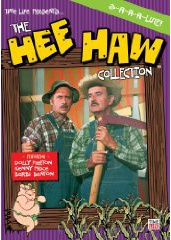
Which is a roundabout way of saying that I started this project baffled as to how anybody might think that Hee Haw was worth preserving for the ages. But sure enough, the good folks at Time-Life Video have an extensive collection of episodes for sale.

Now, admittedly, I’m not the target audience here. I grew up in New England, which was for a long time the one place where country & western couldn’t find a commercial toehold. A middle-class suburban kid like me could watch Hee Haw in syndication, just as with Lawrence Welk and Soul Train, and like them it seemed like a glimpse into a parallel musical universe. Indeed, I thought of Hee Haw as being sort of like Soul Train for rural whites.

But surely Soul Train never condescended to its intended audience as Hee Haw did to its. What I remember of the show is mostly gawping hillbilly stereotypes, popping up amongst plywood cornstalks to deliver jokes that were stale when God was a boy. Who, exactly was meant to be laughing at this, and why?

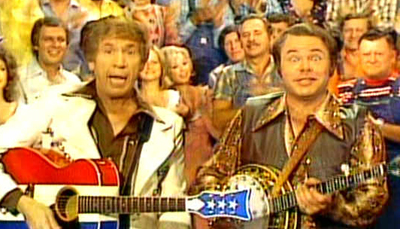
I’ve since come around on country music, as I have on soul and funk (sorry, Lawrence Welk). It’s still not my favorite genre of pop, but I’ve got a lot of time for the craftsmanship, the professionalism, the care and energy that goes into presentation and branding — so much art to make it all look artless. Roy Clark had some fine instrumental chops to go with those lush sideburns; and Buck Owens — well, not only did Buck help create the Bakersfield Sound, he palled around with Ringo, for cryin’ out loud! Looking at it now, Hee Haw’s musical pedigree looks downright promising.
And the show ran for 24 years in syndication, so obviously somebody thought it was worth watching — and worth preserving on DVD. And there are legion of fans who remember the show with fondness. Had I been wrong, all this time? I have no interest in taking cheap shots, so I decided to revisit the show with an open mind. Was Hee Haw better than I remembered? Were all those frightening teeth for real? Was Junior Samples really some kind of unappreciated deadpan-comic genius? I grabbed a disc at random from The Hee Haw Collection — episode #152, from 1974 — and settled in to see what I’d been missing.

Oh my. Oh, my, my, my.

In the wake of the rightward tilt in American politics, Thomas Frank wrote a book called What’s The Matter With Kansas? Frank wondered why it was that red-state Americans tended to vote overwhelmingly for the party whose trade policies were the very things squeezing the heartland the worst — in other words, how so many people could vote against their own economic interests. Assuming that it was this same demographic that kept Hee Haw on the air for a quarter-century, I think I can safely answer Frank: The matter is that rural America has a self-loathing streak a mile wide, and is possessed of a nearly boundless appetite for insult.

Remember the movie Cast Away, where Tom Hanks is stranded on a desert island with a stack of video cassettes, and he braids the tapes into a rope with which to hang himself? That would be a better use for the Hee Haw master tapes. And believe me, by the end of just one episode, I felt inclined to stick my head in a noose.
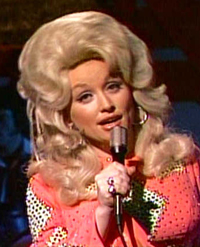
There are some genuine musical pleasures here — Clark dresses up “Gentle On My Mind” with a stinging manouche guitar solo; the late Terry McMillan makes a righteous rip through “The Orange Blossom Special”; Dolly Parton, her hair at its largest and most immobile, cuts through to the heart of “I Will Always Love You” with an achingly simple, genuine performance. But these moments are so fleeting, they’re like flashes of gold in a panful of mud.

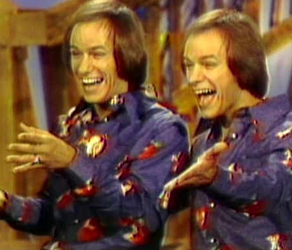
Elsewhere, Hugh Hefner arm-candy Barbi Benton sings as if heavily sedated, head lolling alarmingly from side to side; the Hager Twins — floral shirts, obscenely tight pants, and matching Brian Eno hairlines — are pure nightmare fuel; and the session cats in the backing band alternate between indulgent smiles and aggrieved glowers while hacking it out strictly by the numbers.
The worst offender, sadly, is Buck Owens. He’s still got charm to spare, but to call his performances “perfunctory” would be a compliment. Owens had gone beyond simply phoning in his act; by this point, his act was sending prepared statements to be read by a spokesman.

Roy Clark, for better or worse, at least seems fully engaged. Unfortunately, this means that he treats us to a mean little gay-baiting sketch, lisping and mincing about with lacy frills sewn onto his overalls, to hoots of canned laughter. It’s an ugly moment — ugly in 1974 and uglier now.
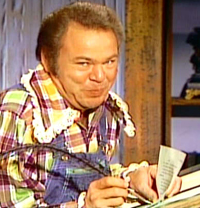
The best that can be said of the sketch is that it’s over quickly. They all are; Hee Haw cribs most of its style, if not its substance, from Rowan and Martin’s Laugh-In — all catchphrase-based humor, two-liners, and rapid-fire editing. It seems an unlikely model, but an extended radio-host routine gives the game away, with its clear echoes of Gary Owens’ shtick.

The line on Hee Haw was that rural audiences dug it because it seemed genuine — plain country folks, laughing at themselves. The show maintained that illusion by co-opting figures from an earlier era of country & western culture, like Minnie Pearl. But the façade is unconvincing. At a couple of points in this episode, we see, poking out from under Buck Owens’ workshirt-and-overall ensemble, a pair of black patent-leather boots, freshly shined, gleaming incongruously. That’s Hee Haw in a nutshell; a bunch of showbiz phonies playing dress-up, and their disrespect for the audience runs so deep that they don’t even bother to do a decent job of faking it.

Tags: , , , , , , , ,

  • Johnny Johnson
    You really aren't the audience for what was, in the best sense of the word, Camp.

    What you take as "disrespect" for the audience is parody with a knowing wink to insiders. It says, "Can you believe that those yahoos from New England think we act like this?" You were tested and failed. Cf. Hillbilly Days in Pikeville, Kentucky.

    Anyone who does not recognize the genius of Junior Samples leads a sad, sad life.
  • "Camp"? I dunno, Johnny; that sounds kind of , y'know...faggy, don't you think?
  • Johnny Johnson
    Yes, it does.

    Now engage the ideas, Jack.
  • Johnny Johnson
    Also, please note that Hee-Haw was a "Gaylord Production."
  • Patrick
    I must have grown up in the hillbilly part of New England, because country was alive and well where I grew up (Franklin County Maine). You're dead on about Hee Haw, though - Buck Owens definitely decided it wasn't worth doing any heavy lifting if most of the others weren't going to try hard. And sure they're phonies - I always thought that was part of Country's charm.
  • David_E
    Hot chicks. Short shorts. 'Nuff said.
  • Old_Davy
    ...with big bazoombahs. 'Nuff said.
  • Eugh. Sorry, man - I know that what turns you on is a very personal metric, but "sexiness" and "the 1970s" are non-convergent fields on the Venn diagram of my sexuality.
  • Gary Lucy
    Really well-written piece! I've kept Hee Haw in the "harmless fun" folder in my brain for many years, but in light of the Bush 43 era we now know where such cynical fake folksiness leads. It's the redneck version of blackface. But! There definitely is some redemption in the music and fashion. And without Hee Haw we would never have this brilliant Jenny Lewis video.
    http://www.youtube.com/watch?v=-Thz2SOKkGI
  • "The redneck version of blackface" . . . yes, that's it exactly.

    Somebody's going to get an advanced degree (somebody probably already has) by studying the proliferation of homosexual stereotypes in 70s pop culture. They look terrifically ugly to most everybody now, but that's our new-millennium sensitivity talking. They were just a part of the landscape back then, and they were everywhere. Clark's was merely one. The recurring gay characters on "Barney Miller" were another. In that show, the scripts took care to have most of the main characters express attitudes of acceptance, but the audience was not required to do so, and did not so much laugh with them as laugh at them.
  • Johnny Johnson
    Clark is actually ripping off Percy Dovetonsils, a character Ernie Kovacs played on his show. E.g., http://www.youtube.com/watch?v=gmEuK_UNwSs.

    You guys are not getting Hillbilly as Cultural Construction, are you?

    Sure, it's the redneck version of blackface. But you ellipsize a necessary step.

    It's the redneck version of African-Americans in blackface.
  • If anything, I figured the Claude Strawberry character to be HEE HAW's version of Henry Gibson's shtick from LAUGH-IN. Both may derive from Kovacs, who of course came earlier; but I think the influence of LAUGH-IN on HEE HAW cannot be discounted.

    The difference, of course, is that Gibson simply seemed so fey as to be otherworldly, whereas Strawberry is a crassed-up, dumbed-down version of that - all text, no subtext.

    And yeah, I get the Cult Studs jazz, and I think your blackface analogy is apt - perhaps even more apt than you intended: don't you find the image of African-American performers in burned-cork makeup to be distasteful? As even more morally offensive than whites in blackface? I don't see it as an oppressed group wilfully co-opting the tools of the oppressor, but rather as the triumph of a prejudicial system, making the oppressed complicit in their own continuing marginalization - exploiting and engendering self-hatred.

    I find those same undercurrents are present in HEE HAW; that's what makes it not just bad, but soul-crushing.
  • Ray
    "You met another and b-b-b-b-b-b-b you was gone."

    Nuff said.
  • Johnny Johnson
    I chaired a session at the American Culture Association. One of the presenters mentioned that her dad went to seminary with Archie Campbell. The room went silent with admiration.
  • Old_Davy
    Before it went into syndication, Hee Haw aired on CBS, and was put on to replace The Smothers Brothers Show which was famously canceled for being too controversial. Hee Haw is the total antithesis of The Smothers Brothers Show. Deliberately unhip, uncool and standing up for American Values (meaning no anti-war material) Hee Haw was a viewing staple while I was growing up. I can still hear my father exclaiming that THIS was real entertainment. As the only non-lover of country music in my family, I merely endured the show for many years. "Hey Grandpa, what's for supper?" "Chicken fried steak with white country pepper gravy, grits with butter and collard greens!" Is there an actual joke in there?

    I have a brother who retired from the country music biz, and he played on Hee Haw several times, and while the show has it's many faults, at least the music was live. No lip syncing, no overdubs, it was all played live before the cameras. The laughter and applause was all canned, but all the music performances were totally live. There was an off-stage house band for solo performers, but most acts brought their touring bands with them.

    And don't you think Roy was just a little TOO good at playing that gay guy??
  • Oh, the musical segments were the one pleasure of the show; the playing was always top-notch, even when the material was subpar - which, frankly, was most of the time.

    I find country music fascinating because it's the one form of American pop that's not predicated on generational conflict. The evolution of rock 'n' roll, and even jazz, is marked by each successive wave announcing This is not your father's music. But country has always emphasized continuity and tradition - it's always aimed to be music that Grandad and Dad and Junior could all enjoy together.

    That's why the producers of HEE HAW co-opted representatives of an older generation of country performers - Minnie Pearl foremost among them. It's telling, though, that the show doesn't actually give Minnie or Grandpa much to *do.* They're window dressing, ornaments - brought in to lend the show credibility-by-association.
  • In the days before we got MTV and all the other channels in the Great Cable Proliferation of the early '80s, my dad kept the family TV on three things -- Atlanta Braves baseball, Masterpiece Theatre and Hee Haw.

    Mix them together, and you get this: "I'm a-pickin', and I'm a-grin- ... Rowland Office at the plate now for the ... days before I saw Flambards, where dashing young pilots competed for the ... fly ball to left field, where Chief Noc-a-Homa ... searched the world over and thought I found true love. You met another and pbbst you were gone."
  • It wasn't that I thought Hee Haw was a cavalcade of stupid people, or smart people playing stupid for the camera... I didn't like it because I felt stupid for watching it; hence, I didn't.
  • JonCummings
    I don't believe I ever watched an entire "Hee Haw" episode while growing up in southwestern Virginia--but I did spend much of my childhood intermittently singing, "Well, we're not ones to go around spreadin' rumors/Really, we're just not the gossipin' kind/Oh, you'll never hear one of us repeating gossip/So you'd better be sure and listen close the first time..."

    No regrets!
  • Transplanted from New England to the middle of Kansas, Hee-Haw proved to be a revelation to this 9-year-old--it aired on one of only three channels we got, the other two being a PBS station and The Static Channel. I was fascinated for quite a while--you're right, in my neck of NH, we didn't get much country exposure. But even at that tender age, I knew prolonged exposure to the program would kill me, or at least erode my IQ until it was in the single digits, much like the number of teeth many of the cast sported (or seemed to sport) on the show. So I started watching The Static Channel.

    And yet, for years afterward, I was convinced I'd seen a young K.D. Lang on the show, wearing--can this be so, or has HH exposure already done its work on my brains?--a sequined skirt. I tried to tell people what I'd seen, but never met anyone who believed me (even you were dubious, Jack, and your willing suspension of disbelief is powerful enough to negate local gravity).

    Anyway...great column. I'm enjoying it muchly.
  • Clyde
    I was a kid when I say KD Lang on hee haw in Dickinson North Dakota. I remember thinking shit they have no idea what they have on tv. I wasn’t the only one in small town America that was gay. Thank God For K.D. Lang and Kee Haw…
  • Noneuhyer Dambuisness
    You're an idiot. Fuck you. I can't really specify one part of your article which was idiotic, and I don't feel like wasting my time going into great detail. Long story short, you don't know what you're talking about... oh yeah, and you're an idiot.

    -an ol' Tennessee plowboy (with a 150pt IQ)
  • JohnHughes
    ...and phhhpptthht, you were gonnnne...
  • Dinos
    Sour grapes about the grand success of what you don't like. Grow up.
  • Jim
    I have begun hearing rumors of a new Hew Haw coming to CMT. Any one got any information.
blog comments powered by Disqus