
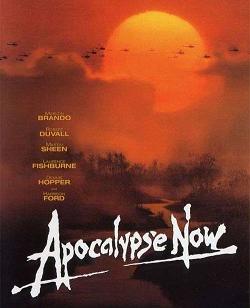
 In my post about The Rules of Attraction a few weeks back, commenter Idp presented the idea that many of the heroes in action movies fall into a subclass of the alpha male as Á¢€Å“reluctant alphas.Á¢€ I think thereÁ¢€â„¢s something to this. A number of classic action movies (Commando, Rambo, Lethal Weapon) introduce their hero as someone who lives in relative isolation and is either persuaded or forced to act in an extraordinary situation. At the same time, these characters continue to resist occupying positions of actual leadership, and the corresponding responsibilities that accompany such positions. The case of Captain Benjamin Willard, played by Martin Sheen, provides an interesting example of this Á¢€Å“reluctant alphaÁ¢€ in both fictional material and in the actorÁ¢€â„¢s real life.
The Film: Apocalypse Now
The Song: Á¢€Å“The EndÁ¢€ (download)
The Artist: The Doors
WhoÁ¢€â„¢s Who:
In this opening scene of Apocalypse Now (1979), weÁ¢€â„¢re introduced to our reluctant hero, Captain Benjamin L. Willard, played by Martin Sheen. ItÁ¢€â„¢s hard to imagine anyone other than Martin Sheen as Captain Willard, although Harvey Keitel had originally been cast to play the part and was actually dropped two weeks after shooting had already begun. Sheen suffered a near-fatal heart attack during production, which was one among many other disasters that came close to shutting the film down entirely.
Francis Ford Coppola, who directed, produced, and helped write the script for Apocalypse Now, was practically broken by the process. Originally George Lucas, while working for American Zoetrope, CoppolaÁ¢€â„¢s fledgling film studio, was supposed to direct the film. Coppola took over the project, directing it himself, and financing it entirely with his own assets after Warner Brothers balked at his plans to shoot the film in Vietnam itself, in the midst of the ongoing war. Eventually the film was shot in the Philippines, although conditions there were suitably horrendous that perhaps shooting in Vietnam itself might not have been that much more difficult.
The Doors released Á¢€Å“The EndÁ¢€ on their self-titled first album. Although it was released in 1969 and the song contains some phrases and images that suggest itÁ¢€â„¢s about the Vietnam War (lines like Á¢€Å“lost in a Roman wilderness of pain,Á¢€ and Á¢€Å“the killer awoke before dawnÁ¢€¦he put his boots onÁ¢€), Jim Morrison himself admitted that he really wasnÁ¢€â„¢t sure what it was about. Like many of the DoorsÁ¢€â„¢ songs, MorrisonÁ¢€â„¢s cryptic lyrics overshadow the musical talents of the remaining members Robbie Krieger (guitar), Ray Manzarek (keyboards), and John Densmore (drums).
[kml_flashembed movie="http://www.youtube.com/v/aCUQtbZ3Tbs" width="425" height="350" wmode="transparent" /]
Why it Works:
Enough has already been said about the opening shot of a pristine jungle bursting into napalm-fueled flame serving as a metaphor for the Vietnam War itself. But another purpose the super slow motion and meandering fades to Captain Willard in his room in Saigon serve is to announce to the viewer in no uncertain terms that in order to enjoy this film, you will need to be patient. It was a very long war, and this is a very long movie.
The original rough cut of the film was four and a half hours long. When it premiered at Cannes in May of 1979, it was a Á¢€Å“work in progressÁ¢€ with a length of about three hours. After even more cuts, the theatrical version released in August of 1979 was still just over two and a half hours. The more recently released Redux version restored an additional 49 minutes worth of footage, resulting in a final version of the film that is almost three and a half hours long.
ItÁ¢€â„¢s difficult to imagine the voice-over narration could work nearly as well without SheenÁ¢€â„¢s patient, gravelly delivery. The drifting strains of Robby KriegerÁ¢€â„¢s guitar at the beginning of Á¢€Å“The EndÁ¢€ provide an excellent companion to the yellow flare dust kicked up by the helicopters. The audio transition from helicopter rotors to an overhead fan back to helicopter rotors again is just damned clever, and works brilliantly. It’s just a great scene, where the music matches well with the images on the screen.
What Goes Wrong:
Captain WillardÁ¢€â„¢s drunken outburst, where he punches through the mirror, actually occurred on the actorÁ¢€â„¢s 36th birthday, after Sheen had been drinking all day. This may generate some disagreement, but once the film moves past this initial scene, it becomes clear that Captain Willard is not an alcoholic. This is in evidence at Colonel KilgoreÁ¢€â„¢s landing zone beach party, when they Á¢€Å“choppered in t-bones and beer.Á¢€ While Willard is content to sip on a Schlitz (in contrast to the Budweiser that mostly everyone else is drinking), he seems to remain sober, at least more so than anyone else.
Sheen has admitted that he was battling an alcohol addiction at the time the opening scene was shot. He reportedly insisted on continuing to film while blood poured from his injured hand, despite CoppolaÁ¢€â„¢s reluctance. While a number of actors have suffered an unhealthy influence from their charactersÁ¢€â„¢ substance abuse issues (River Phoenix in My Own Private Idaho is the most famous example) it is very uncommon that the off-camera actions of an actor actually influence way a character is developed, and this scene serves as a rare example of just that. While the footage is fascinating to watch, it doesnÁ¢€â„¢t actually tell us much of anything about Captain Willard, or at least nothing that remains consistent with his future behavior in the film.
Other Stuff:
Throughout the film, while remaining committed to his mission, Willard steadfastly denies any kind of leadership role. Although he holds the rank of captain, we rarely see him giving orders. And while the crew of the boat seem drawn to him, he cedes authority to the boatÁ¢€â„¢s commander, Á¢€Å“ChiefÁ¢€ Phillips, whenever possible. He bestows a begrudging respect on Colonel Kilgore (although an added scene in the Redux version contradicts this) and refuses to be drawn in to a pissing contest with him when making arrangements to get the boat into the Mekong River. Willard is clearly reluctant to accept ChefÁ¢€â„¢s help, when offered, fearful of having anyone else suffer the consequences for his mission other than himself. And he is openly called out by Kurtz as an Á¢€Å“errand boy,Á¢€ for accepting the orders of who Kurtz considers lesser men.
This is curious in that it mirrors Martin SheenÁ¢€â„¢s behavior off-camera. He has been a fierce advocate of liberal causes, supporting various environmental and labor groups. In addition, he has declared himself to be a pacifist and has been very vocal in his opposition to war in general, particularly the ongoing Iraq War. However, when approached by the Democratic Party in Ohio about the prospect of running for Senator, he declined, insisting that he was an actor, not a politician.
In both the case of the character Captain Willard and the real-life Martin Sheen, we see a potential alpha male who is leery of the responsibilities that are associated with positions of leadership. Captain Willard knows that there can be grave consequences for those who support him in his mission, and Martin Sheen knows that a person needs more than just celebrity status to be an effective politician. Perhaps he had a better understanding of the rigors of a national campaign than fellow fictional president Fred Thompson did when he allowed himself to get drafted into his failed bid for the presidency. In terms of experience, however, I donÁ¢€â„¢t see how Martin Sheen would be any less qualified to hold public office than Ronald Reagan or Arnold Schwartzenegger. And IÁ¢€â„¢m not sure what made Martin Sheen decide that being a former alcoholic with an aversion to serving in the military would disqualify him from holding an elected office, but itÁ¢€â„¢s obviously not true.
Comments