

This was a tough weekend for political junkies Á¢€” particularly those whose televisions generally find themselves tuned to NBC-related channels. Tim RussertÁ¢€â„¢s death on Friday at the far-too-young age of 58 was nothing less than a cataclysm in this riveting campaign season. He was not just a fixture among the TV commentariat Á¢€” he was the unquestioned Lord God King of on-air political analysis, the most credible voice on a Tuesday election night as well as the most reliable among all the Sunday-morning quizzers of politicians and pundits.
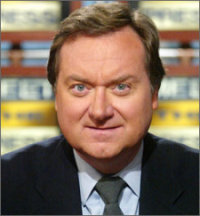 The weekend was a wall-to-wall weepfest on MSNBC, starting with the raw emotions of Friday evening (when Keith OlbermannÁ¢€â„¢s makeup people couldnÁ¢€â„¢t keep enough pancake on his cheeks to hide the tears, and the pain showed through even on Andrea MitchellÁ¢€â„¢s surgically improved and/or heavily Botoxed face). By Saturday, an hourlong tribute hosted by Tom Brokaw was running on a loop, and on Sunday Brokaw moved over to the mothership to serve as ringmaster for a televised wake on Meet the Press.
Even after all that catharsis, a huge hole remains evident in the Á¢€Å“political cultureÁ¢€ that this column aims to explore. DonÁ¢€â„¢t worry, IÁ¢€â„¢m not going to pursue the general hagiography of Russert, what a great guy he was and what a wonderful son; you can find that elsewhere (and besides, IÁ¢€â„¢ve seen enough of Á¢€Å“Big RussÁ¢€ this weekend to last me my whole life). What concerns me is the fact that Russert was such a uniquely talented inquisitor and commentator, that his words and deeds had such an impact on the political scene Á¢€” and that there is no one currently in the TV-journo profession who stands even a ghost of a chance of filling his shoes.
Russert, quite simply, was the definitive voice of this political age Á¢€” from his dressing-down of David Duke in 1992 to the whiteboard reading Á¢€Å“Florida, Florida, FloridaÁ¢€ on election night 2000, and straight on to his dramatic pronouncement after last monthÁ¢€â„¢s North Carolina primary that Á¢€Å“we now know who the Democratic nominee is going to be, and no oneÁ¢€â„¢s going to dispute it.Á¢€ Hillary Clinton didnÁ¢€â„¢t like that last proclamation, nor did she abide by it, but she was practically the only one who didnÁ¢€â„¢t; though she went through the motions for four more weeks and racked up $20 million of debt, RussertÁ¢€â„¢s was the last word on the campaign for many millions of Americans.
 Still, I come here not merely to praise Russert, but to bury him a little bit as well. Much has been made of his role in the Scooter Libby trial last year, when Dick Cheney was revealed to have said that Meet the Press was the one program on which the Bush administration could most effectively promote its agenda. That comment exposed RussertÁ¢€â„¢s style as being a bit too accommodating, a bit too unwilling to speak truth to power, even as he gave the appearance of nailing his guests so effectively. Too many Russert interviews Á¢€” though there were notable exceptions (Duke, Ross Perot) Á¢€” featured the host as a champion matador, maneuvering the bull(shitter) around the arena and leaving him a bit discombobulatedÁ¢€¦but then, in the end, refusing to plunge the sword in. RussertÁ¢€â„¢s mournful colleagues spent this weekend revering his ability to pursue the follow-up question and reveal a politicianÁ¢€â„¢s response for the boilerplate it was, but too often his guests could get him to move on to another topic simply by offering up the same tripe in response to that follow-up.
Just as insidious, I think, was the unintended consequence of RussertÁ¢€â„¢s signature move: to play a videoclip or read a newspaper quote showing a contradiction between a politicianÁ¢€â„¢s current policy or position and what he might have thought or done in the past. ItÁ¢€â„¢s one thing to show Cheney a tape of himself claiming, Á¢€Å“WeÁ¢€â„¢ll be greeted as liberators,Á¢€ and ask him to defend it or admit heÁ¢€â„¢d screwed up. ItÁ¢€â„¢s another to show a two-year-old quote of a senator railing against the war, then ask him why heÁ¢€â„¢d voted to fund it — or to point out the inconsistency in a five-year-old quote denying global warming and a recent decision to support cap-and-trade.
This technique of RussertÁ¢€â„¢s contributed mightily to the criminalization of Á¢€Å“flip-floppingÁ¢€ in our politics. Our current president seems positively obsessed with avoiding flip-flops of his own, and equally fanatical about pointing out the supposedly nefarious position-shifting of others. The result has been an administration that resolutely refuses to learn from its innumerable mistakes, or to adjust its policies to emerging facts or changing realities. RussertÁ¢€â„¢s too-frequent games of Á¢€Å“gotchaÁ¢€ occasionally exposed blatant opportunism (paging Mitt RomneyÁ¢€¦), but if an otherwise upstanding politician is no longer allowed to change his mind once in awhile, the resulting inflexibility of our nationÁ¢€â„¢s governance inevitably will bring about more Iraqs, Gitmos and Katrinas.
 Despite these substantial chinks in the armor, Russert was an immensely credible Á¢€” and simultaneously likeable Á¢€” figure, the likes of whom will not likely appear again soon. Who that remains in the pundit class carries that kind of credibility? Certainly not wonder-boy George Stephanopoulos, whose performance yesterday on his ABC program This Week only underscored RussertÁ¢€â„¢s preeminence. Stephanopoulos usually makes little effort to challenge his interview subjects, even when they are guilty of the most baldfaced lies Á¢€” as Fred Thompson was yesterday in claiming that Guantanamo detainees have always had the ability to appeal their cases to a U.S. appellate court. He also stepped in it during that infamous pre-Pennsylvania debate in April, which featured questioning so squalid that Obama obviously thought, Á¢€Å“I donÁ¢€â„¢t have to put up with this anymore.Á¢€ Stephanopoulos gives good roundtable, I suppose, but he seems reticent to put forward his own opinions or perspective in a way that would move him up to RussertÁ¢€â„¢s league.
Meanwhile, NBCÁ¢€â„¢s own stable of hosts and pundits now looks kinda like the Bulls without Michael Jordan. Who will host Meet the Press? More important, who will step up with the gravitas and the Á¢€Å“Q scoreÁ¢€ to put him/herself out there every morning on Today, every evening with Brian Williams, every so often on Hardball or Countdown Á¢€” and, crucially, during the conventions and on election night?
 Chris Matthews shares many of RussertÁ¢€â„¢s characteristics Á¢€” Catholic, working-class background, garrulous personality, encyclopedic knowledge. But Matthews always seems to be on the make, always has seemed to be looking enviously up at Russert (a fact he admitted on his own show yesterday) and suspiciously across the primary-night anchor desk at Olbermann. Matthews also is too much of a chatterbox and is too impressed with his own opinions to be a good moderator for Meet the Press, which is supposed to be a showcase for the interviewee, not the interviewer.
Olbermann is on the rise, but heÁ¢€â„¢s too blatantly partisan to take over the flagship news-interview show on television. In all the hours IÁ¢€â„¢ve watched him, IÁ¢€â„¢ve never seen him debate or truly challenge an interview subject; he never has to, because he only books pundits and politicos who agree with him. He needs to stay where he is, on Countdown and at that election desk, and continue to lead MSNBC in storming the Fox barricade.
 Mitchell is a skilled commentator with more acquired credibility than anyone else at NBC; she is a good bet to take over RussertÁ¢€â„¢s ubiquity on NBC and MSNBCÁ¢€â„¢s political coverage, at least in the short term (my mancrush Chuck Todd is the obvious long-term solution). But her age and lack of sustained experience as a questioner argue against her being a long-term solution for Meet the Press.
 Then thereÁ¢€â„¢s David Gregory. HeÁ¢€â„¢s intelligent, young, pretty, and well-known. HeÁ¢€â„¢s got plenty of interviewing experience, gained from his weekend and fill-in duties on Today. HeÁ¢€â„¢s proven he can challenge the establishment, as one of the first White House correspondents to snap out of the lapdog lethargy that helped enable the Iraq War. However, conservatives despise him for that very reason, and his new MSNBC show Race for the White House (widely seen as an audition to take over MatthewsÁ¢€â„¢ timeslot when the Hardball hostÁ¢€â„¢s contract runs out next year) has so far been far too lightweight and gimmicky. He seems like the best in-house candidate to be a long-term host of Meet the Press, but he has some work to do in the credibility department.
NBC no doubt will look to promote from within, but Á¢€” as our own Dw. Dunphy unwittingly noted last week before Russert’s death Á¢€” thereÁ¢€â„¢s an external (but not too far outside the walls) presence who just might be looking for a job in the near future. Katie Couric has failed to connect with viewers of the evening-news format, but her ability to connect with morning-TV audiences, and with her interview subjects, is difficult to dispute. She even has some highly publicized experience in challenging politicians on their positions or veracity. (Of course, sheÁ¢€â„¢s still prone to those too-cute-by-half moments, as when she recently asked Obama if the prospect of making Hillary his running mate might make him think, Á¢€Å“Bleah.Á¢€)
 Couric wouldnÁ¢€â„¢t make anyone forget Russert, but she is the type of high-profile figure who might be best able to keep politicos flocking to Meet the Press, while keeping large numbers of viewers tuned in. Plus, she would dramatically pump up the perkiness meter on Sunday mornings, which currently hovers right around zero. (The chat-show Miss Congeniality contest currently is pretty much limited to a throwdown between Mary Matalin and Doris Kearns Goodwin.) Just a thoughtÁ¢€¦
In the meantime, RIP, Tim. You left us way too soon Á¢€” particularly in this momentous political year Á¢€” but thank goodness we had you around as long as we did.


Comments