

If youÁ¢€â„¢ve watched the TV news carefully this week, you may have noticed that somewhere amidst the all-Russert-all-the-time lovefest there were other events taking place Á¢€” some of which might have benefited from some Russertian analysis.
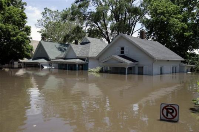 There are, of course, massive floods up and down the Mississippi River Á¢€” a Á¢€Å“500-year floodÁ¢€ that has taken out levees up and down the Iowa-Illinois border, according to the Army Corps of Engineers. The enormous damage to homes and lives has often taken a backseat to worries about the damage to the Midwest corn crop. (Less ethanol next winter! More food riots in Africa!)
There is the Bush-McCain pas de deux on oil drilling, with both men suddenly insisting that Congress open the waters off our shores to Á¢€Å“exploration and exploitationÁ¢€ (as McCain put it) for the first time in 28 years. Failing to do so, one of them said (I canÁ¢€â„¢t remember which Á¢€” itÁ¢€â„¢s hard to tell them apart), would doom our nation to many more years of gas prices like weÁ¢€â„¢re seeing now ($4.63 at the local Chevron this afternoon).
And then there is the re-emergence of Rudy Giuliani to shore up McCainÁ¢€â„¢s dipping foreign-policy numbers and to rationalize his slipping appreciation for American values. In the wake of last weekÁ¢€â„¢s Supreme Court decision restoring some measure of habeas corpus rights to Gitmo detainees Á¢€” and with his 9/11 blinders enabling him to ignore the resurgent violence in Iraq and Afghanistan Á¢€” Rudy trotted out an oldie but goodie, accusing Barack Obama ofÁ¢€¦wait for itÁ¢€¦reverting to a Á¢€Å“September 10 mindsetÁ¢€ when it comes to applying the (god forbid) Constitution to our treatment of Á¢€Å“enemy combatants.Á¢€
 The media has treated these three developments separately, but to me theyÁ¢€â„¢re all part of the same story. Simply put, our nationÁ¢€â„¢s disastrous energy policy is breaking us financially Á¢€” and when itÁ¢€â„¢s not busy doing that itÁ¢€â„¢s getting us killed around the world, or avoiding the middleman and ravaging us at home via the type of extreme weather that just might portend a climate-change apocalypse. Out-of-control oil prices, Middle East instability and global warming are related problems that require a unified solution. It inevitably will be the task of the next president, even if itÁ¢€â„¢s John McCain, to begin the long-delayed process of weaning this nation (and eventually the world) off of oil and other fossil fuels.
Bush and McCain are gambling that if they can get out front on combating high gas prices, they can blunt the impact of Al Gore, who returned ferociously to the stump on Monday and whose message is helping drive younger voters overwhelmingly to the Democrats. TheyÁ¢€â„¢re also hoping that by harping exclusively on the need to lower gas prices in the short term, they can make us forget their (and the Republican Party in generalÁ¢€â„¢s) starring role in creating the conditions for our current crisis Á¢€” i.e., the Iraq War, deregulation of the futures market, tax giveaways to the oil companies, hand-holding of the House of Saud, etc., etc.
 Their misdirection has some chance of succeeding, if voters become mesmerized by those numbers clicking by ever more quickly on the gas pump. Never mind that the offshore-drilling gimmick is just as much a ruse as the gas-tax holiday to which McCain still clings Á¢€” new exploration now wouldnÁ¢€â„¢t result in increased supply (or the supposedly attendant lower gas prices) for at least 5-10 years, and the oil companies likely would just pass their drilling costs along to us. The GOP is counting on voters to ignore the larger issues of energy policy, and to forget the partyÁ¢€â„¢s complicity in creating our current mess, in favor of a simple question: Who will lower my gas prices sooner?
Simultaneously, McCain and his surrogates are banking on their ability to use the same old rhetorical tricks to make voters develop amnesia when it comes to the Bush-led RepublicansÁ¢€â„¢ abject failure to thwart al Qaeda, pacify Iraq or Afghanistan, secure our vulnerable ports and infrastructure, or unify the world community in anything beyond disgust at our recent policies and actions. GiulianiÁ¢€â„¢s 9/11 obsession didnÁ¢€â„¢t get him past Florida this winter, and the GOPÁ¢€â„¢s tough-on-terror message finally got drowned out by their own scandals and incompetence in the Á¢€â„¢06 midterms, yet here they go again. And who knows? Maybe theyÁ¢€â„¢ll succeed in turning Obama into the bogeyman.
However, thereÁ¢€â„¢s a much better chance that Á¢€Å“conditions on the groundÁ¢€ Á¢€” you know, that inconvenient set of verities that non-Republicans call Á¢€Å“realityÁ¢€ Á¢€” will overwhelm these Bush/McCain schemes. Events like the massive car bomb in Baghdad this week might tend to undercut the War GurusÁ¢€â„¢ Á¢€Å“surge-is-workingÁ¢€ mantra, while the TalibanÁ¢€â„¢s brief takeover of Kandahar may blunt any attempts to resurrect the traditional Á¢€Å“vote-Republican-or-dieÁ¢€ message.
 This weekÁ¢€â„¢s revelations of shoddy post-Katrina work by Halliburton/KBR may remind folks that entrusting the government to corporate-purchased goons hasnÁ¢€â„¢t worked out so well. And those pesky floods that pushed Bush into TuesdayÁ¢€â„¢s Á¢€Å“IÁ¢€â„¢ve been to too many disastersÁ¢€ knee-slapper? Well, the best that conservative climate-change deniers can hope for is that the rising waters will push from public view the towns from Kansas and Oklahoma to Georgia and Virginia that were decimated by tornadoes the last couple months. Those folks are already waving their arms about and shouting, Á¢€Å“Remember us?Á¢€ Meanwhile, the American Red Cross is about to run out of money for disaster relief. Katrina victims? Fuhgeddaboutit. TheyÁ¢€â„¢re so 2005.
Still, the burden falls on Obama (and Gore, and anyone else whoÁ¢€â„¢s willing to take up the challenge) to look beyond these day-to-day events Á¢€” and even beyond the steadily climbing price of a barrel of oil Á¢€” and convince Americans to take a good look at the big picture. Bill Richardson was the first presidential candidate to get this right, way back in the winter of Á¢€â„¢07, when he said that we need a Á¢€Å“space-race-level commitmentÁ¢€ to transform our civilization from one based on fossil fuels to one based on renewable energy sources. Obama needs to pull the strings of our rapidly unraveling domestic and foreign policies together, and unite Americans behind the idea that such a transformation will at once revive our economy (by fast-tracking technological advancement and infrastructure conversions), eliminate our hat-in-hand reliance on the tumultuous societies of the Middle East, and, oh yeah, save the planet.
Even the most ambitious politicians insist that completing this transformation will require at least 50 years, but I say, screw that. Scientists are convinced that, with a sufficient investment of public and private funds, it should take no longer than a generation. Of course, that means 20-25 years of putting up with higher energy prices and other sacrifices; it also means two decades of fighting the oil companies tooth and nail for every concession along the way to eliminating their relevance entirely.
 ThatÁ¢€â„¢s OK; bring it on! You say the oil companies are clamoring for the ability to drill off our shores and tap into untold reserves of crude? Well, anybody whoÁ¢€â„¢s seen the repulsive way in which oil derricks have marred the vistas from the Pacific coast at Santa Barbara will be sickened by the notion of more offshore drilling. But letÁ¢€â„¢s make a deal: Give the oil companies a limited window of time to explore and drill and rake in profits Á¢€” say, 25 years. But for every oil rig they construct in U.S. coastal waters, they must also put up a couple thousand wind turbines in the Great Plains, or a few hundred solar panels in the desert Southwest Á¢€” and they must not attempt to pass their costs onto consumers.
At the end of that quarter-century, the derricks must disappear. By then, if all the other sectors of the economy have done their jobs, demand for that oil will have dissipated anyway, and Big Oil and Big Coal should be well on its way to transforming themselves into Big Solar and Big Switchgrass. At that point, Americans hopefully will have commenced exporting our new technologies, vehicles and infrastructure to China, India and the worldÁ¢€â„¢s other emerging economies, all with a goal of reducing the worldÁ¢€â„¢s greenhouse-gas emissions 90 percent by 2050.
 All of this will require enormous sacrifices of time, convenience, hard work and, yes, money by governments, businesses and individuals. And sure, itÁ¢€â„¢s a pipe dream. But, right now, so is filling up a gas tank for less than $60. So is a reasonable conclusion in Iraq Á¢€” or capturing Osama bin Laden. And so is the idea that enough sandbags might stem the rising Mississippi Á¢€” or that, once the polar ice cap finishes melting, there might be enough sandbags in the whole world to save the Florida coastline. WeÁ¢€â„¢ve already wasted eight years failing to solve any one of these problems. The time has come to start tackling them all at once, with a collective sense of urgency, commitment, and…hope. It’s time to dig in.


Comments