Pop Politico: “Debt Nation”

Ted Asregadoo October 28, 2008 11

When I was growing up, I remember my father used to keep a credit card hidden in the back of his closet.  It was one of those “In case of emergency” things that he rarely used.  If he did use it, he paid it off at the end of the month.  So, I had it embedded in my mind that if I ever got a credit card, that I had, had, had to pay it off at the end of the month if I ever made a charge.  And for the most part, that’s what I did.

I was surprised when I got a my first credit card.  It was a department store card that came in the mail weeks after I filled out an application at a table in the quad during my first year of college. I had a part-time job that paid minimum wage, and I put down what I earned at the job figuring I’d never get approved for credit.  After all, I didn’t make much money, so why would a credit card company take the risk?  Ha!  Macy’s looked at the “financial me” that was on the paper application, and stamped out a card with my name on it. A few days after it arrived, I went to the mall and bought some socks and a shirt, and felt some unease when I presented my card.  “Will they accept this from such a fresh-faced kid?” I thought.  Yes they did.  And then I did something naive:  I ran upstairs and paid my credit card bill because I thought it was the responsible thing to do. The woman at the credit department had a good laugh when I pulled cash out of my wallet to pay for the credit charge I just made.

She just worked there as an hourly employee, but I’m sure somewhere in the thicket of the billing department, some salaried analyst cringed.  Why?  Well, my behavior marked me as a deadbeat.

Yes, financial responsibility equals “deadbeat” in the world of credit. And until the financial meltdown, credit card companies were on the hunt for “revolvers” whose financial behavior was that of an addict who couldn’t stop spending and needed a little something “extra” to help them get what they needed. Maybe you were one of the, um, lucky ones who would get weekly credit card solicitations tempting you with 0% APR for six months.  Did you ever wonder how they made money on those 0% cards?  Well, it took time to loosen the laws controlling things like interest rates, late fees, and other fees that could be tacked on whenever a credit card company felt like it (as long as they notified you within 15 days). But after 20 years, credit card companies were able to get what they wanted:  a complex contract between the company and the individual that structured the terms with little to no government oversight and no real recourse if you felt like you were getting a fist rammed up your anus. In 20 short years, we’ve gone from a form of debt that was used sporadically by many people (and was hard to get), to an economy largely built on debt spending.

As middle class wages stagnated (spurred in large part to the globalization of labor in manufacturing), the cost of living increased, and the gap between wages and expenditures grew, the 0% APR card became the way in which people could bridge that gap and still feel like they were living the American Dream.  But of course, it all came at a price, and now that we’re in a financial pinch, credit card companies are doing things that, while within their contractual rights, are basically souring the milk individuals have been sucking on for over a decade.

What are they doing to sour the milk? Well, these companies are using the same “financial behavior profiling” they used to identify “revolvers” (their prized customers), but are now assessing their overall risk of default in a different way.  If the risk is too high (and no one except the credit card companies make that determination), they cut the credit limits of revolvers to roughly the amount they have outstanding in debt.  So, let’s say you’re a revolver and have $30,000 in debt — but you thought your limit was $40,000 — well, the company now says that your new limit is amount of your debt. Now let’s say you make a $10,000 payment so you can have a $10,000 cushion in case you need it.  Well, the company could reset your limit to your new balance so that your $30,000 limit becomes $20,000. The more you pay down your debt, the more they can decrease your limit.  It is a way companies control the risk of default, but you see what’s happening here, don’t you?  The contraction of credit means the velocity of money will slow and so will the economy — and this is on the individual level.  At the institutional level, you have to follow indicators like the Libor rate and the TED spread, but a similar thing is happening.  Credit is contracting, governments are shoveling money into the system to loosen the flow of money and reduce the severity of the recession. Money is being put in, but, it’s not trickling down in the form of loans to individuals.  Instead, banks like JPMorgan Chase are using taxpayer money to buy up the competition and get tax breaks to boot.  Huh, what?

So for all the money we as taxpayers are loaning to these financial wizards, what are we getting in return? It seems it boils down to this: financial austerity for individuals, and financial rewards for the companies who created the scheme that lead to the crisis we’re in.  Pretty much the same deal we’ve been getting for over 20 years.

  • steve

    Great piece Ted. The story of your first card is an near exact replica of mine. I was 18, making $3.50 an hour, and it was a Hecht's card. To this day I have carried a balance only twice in my entire life, both times before I was 20. I buy only what I can afford, barring medical emergencies.

    I don't need to repeat my mantra that our current crisis is mostly the fault of the fat, bloated, greedy American consumer, who seem to collectively think that no standard of living is high enough and are obviously willing to go into mounds of debt to have more. To Americans, things and possessions are like a drug, and the more they have the more they want. That cell phone looks cooler, so throw the old one out even though it works fine and get a new one. But then turn around and moronically say “I'm concerned about Global Warming”. Yeah. Okay. Whatever dude. Read my other comments here.

    http://popdose.com/the-final-debate-plumbing-so…

    Oh and BTW did anyone catch the news last week of Apple's record sales of IPhones? http://www.thebusinessedition.com/apple-inc-see…

    Yeah, some economic crisis we're in. The IPhone used to cost $400 and now it “only” costs $199. Not to mention with all services etc your real cost is $1800.00 over 2 years. And they just had record sales in these “dismal” times. How many people were out spending that kind of money in 1930 after the depression? Ah, charge it. Even though you can't afford it, you HAVE to have an IPhone. What will your friends think of your antiquated Razor?

    But hey, those among us who practice fiscal discipline and who actually save money and live within their means will pay more taxes to bail out the ignorant, greedy, Americans who can't seem to control their drug habit. To you folks I just say, your welcome, but I have one thing you'll NEVER NEVER have.

    Enough.

  • http://www.popdose.com Ted

    I hear you on rampant consumerism, but my larger point is that there are two in this dance: the credit card companies who find new ways to shake us down for money (but because of their reckless business practices get bailed out by taxpayers), and those of us who use credit to maintain a lifestyle that leads to high debt, but are now punished by the very companies who are getting coddled by the government.

  • http://www.ideasonic.com Jonathan

    Great piece Ted. Unfortunately or rather due to my reckless mismanagement, I have a huge pile of debt – credit cards and personal loans. At least, I am glad I had the foresight of what I was getting into (though it came a little late). I have been quite prudent in my spends for the last 1 year and have been consistently reducing my debts but I do still have a long way to go. I hope I dont change track..

  • http://www.debtchallenges.com Evelyn Guzman

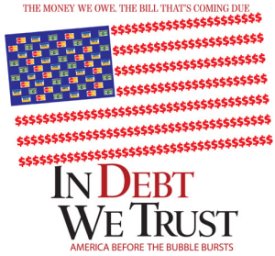
    I don't think you believe in “In Debt We Trust.” I can tell with your behavior when you made your first purchase at Macy's that you don't trust it at all although I know you tried to pay for it because you didn't know what to do. You really learned from the model your father showed you when you were growing up. Lucky you!

    Evelyn Guzman
    Debt Challenger

  • steve

    You're right Ted, I'm not saying the credit card companies are blameless. Yes, we need smart regulation and we need to enforce it and impose stiff penalties that actually mean something when infractions occur. But of the two parties in “the dance” – the American consumer and the credit card companies – the consumer has all the power. If they choose to behave in a fiscally responsible manner and spend only what they can afford, they would make it very tough for the credit card companies to do them harm. A 25% interest rate doesn't really hurt when you carry no balance. We can give them the ultimate finger by just being responsible with our money. But greed drives America, and that will never happen.

    And as you can tell by my past comments, I've noticed over the past decade that cellphones and the flat-screen TV transition are a great way to gauge the blatant wasteful consumerism got-to-have-it ways of the bloated American. Cellphones are like a safety-blanket and a life-giving teet, and no price is too much to pay for the latest/greatest. So with that said, it will be fun to see how many units – in these “dismal” economic times – Google will sell of it's new phone, to be released soon.

    http://www.google-phone.com/google-phone-is-com…

    And almost every single person who buys one will already have a perfectly good cellphone that works fine. Consume, throw-out, consume, throw-out….

  • http://www.popdose.com Ted

    You're right about me being circumspect about debt — I used the graphic in an ironic way.

  • http://www.popdose.com Ted

    Did you see today's economic news? Consumer spending is down 3%, more people are delaying gratification by using layaway plans, and they are driving less. You're right, people do have the power, and in a consumer capitalist country such as ours, it's sad that what's going on above is the wrong thing to do in terms of economic health. Having said all that, just know that I'm not running out to buy stuff I don't need — though that Google phone OS is pretty darn slick. :-)

  • http://www.popdose.com Ted

    You're right about me being circumspect about debt — I used the graphic in an ironic way.

  • http://www.popdose.com Ted

    Did you see today's economic news? Consumer spending is down 3%, more people are delaying gratification by using layaway plans, and they are driving less. You're right, people do have the power, and in a consumer capitalist country such as ours, it's sad that what's going on above is the wrong thing to do in terms of economic health. Having said all that, just know that I'm not running out to buy stuff I don't need — though that Google phone OS is pretty darn slick. :-)

  • http://www.popdose.com Ted

    You're right about me being circumspect about debt — I used the graphic in an ironic way.

  • http://www.popdose.com Ted

    Did you see today's economic news? Consumer spending is down 3%, more people are delaying gratification by using layaway plans, and they are driving less. You're right, people do have the power, and in a consumer capitalist country such as ours, it's sad that what's going on above is the wrong thing to do in terms of economic health. Having said all that, just know that I'm not running out to buy stuff I don't need — though that Google phone OS is pretty darn slick. :-)