
The Á¢€Å“hit the ground runningÁ¢€ strategy the Obama Administration has adhered to since the inauguration has an unfortunate side effect:Á‚ It’s making people impatient for positive change in the economy, the war in Iraq, and the general sense of malaise that has permeated not only the U.S. but most of the world as well.
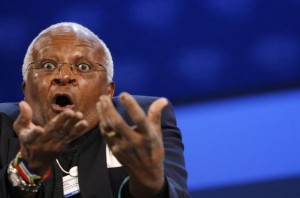
Managing expectations is a tough thing to do when, for example, ObamaÁ¢€â„¢s presidential campaign was premised on the keywords of Á¢€Å“ChangeÁ¢€ and Á¢€Å“Hope.Á¢€ People are expecting rapid change; a wave of a magic wand and things will be Á¢€Å“back to normal.Á¢€Á‚ But whatever Á¢€Å“normalÁ¢€ was, weÁ¢€â„¢re not going back — hell, I donÁ¢€â„¢t think we even want to go back.Á‚ Clearly, weÁ¢€â„¢re at the proverbial turning point where the current economic problems that plague the worldÁ‚ arenÁ¢€â„¢t going to go away in a few months. And if there were ever an image that sums up the shock, frustration, and collective inability of the worldÁ¢€â„¢s leadership to manage this crisis, it would be Desmond TutuÁ¢€â„¢s excessive emoting at the World Economic Forum in Davos, Switzerland.
As the political culture in Washington D.C. frets over the likes of Tom Daschle and certain provisions in the economic stimulus plan, there’s very little talk about the nature of the global economic mess we’re in. Perhaps it’s just easier to concentrate on taxes owed, pork barrel spending, what constitutes lobbying, but it seems whatever heavy lifting that is done by our friends in the mainstream media to enlighten us plebs on the details of this economic crisis, is undercut by a plethora of “sexy news stories” designed for easy consumption.Á‚ Fortunately, the information is out there, and while it’s not really that sexy to read, it does illuminate the enormity of the crisis and how we got to where we are.
To wit: The Economist has a wonkish, but ultimately helpful feature in the January 24th-30th edition that was broken up into a series of articles examining the current financial crisis from a number of perspectives.Á‚ Now, IÁ¢€â„¢m not an economist, but after reading through the articles, I have a good sense of why the economic leaders who convened in Switzerland havenÁ¢€â„¢t a clue what is to be done.Á‚ Ideology and downright confusion over the mechanisms that brought us to this current state have a great deal to do with it.Á‚ Not all who attended the conference were die hard capitalist, but many were and it seems the Á¢€Å“way outÁ¢€ of this mess involves a partnership with an entity capitalists tend to dread: the State.Á‚ Like it or not, the State is the only entity with the wherewithal to instill an important Á¢€Å“soft factorÁ¢€ in the economy: optimism.Á‚ Optimism bolsters trust, and our capitalist economies thrive when these, admittedly, difficult to quantify variables are strong.
In the U.S., Japan, many parts of Europe and the like, belief in trust as an economic determinant is kind of amazing when you think about it.Á‚ For example, when I want to buy a car, a dealer must first trust that the currency IÁ¢€â„¢m using to buy the car has enough value to match the list price.Á‚ Now, if IÁ¢€â„¢m not the type of guy who can walk into the dealership with a bag of cash (pieces of paper built on trust), or funds in the bank that I can transfer by signing a check (another form of trust), then I have to get credit (also based on trust). Fortunately, there are banks in the business of lending me the money –Á‚ which they generally trust that IÁ¢€â„¢ll pay back over a period of time. I sign legal agreements saying IÁ¢€â„¢ll adhere to the terms of the contract, the dealership has assurances from the financial institution that my credit is good, they have confirmation of my employment status, yearly income, FICO scores, and all the other requirements that are needed for the transaction to occur. If those assurances of trust are met, then they hand me the keys and I drive my new car home. ItÁ¢€â„¢s a fairly simple process when the the terms of a purchase contain variables of trust that can be confirmed, quantified, and legally binding.
It gets tricky when, for example, weÁ¢€â„¢re talking about the combination of real estate, credit, and the gambling nature of financial services — which, according to The Economist, is a different animal of capitalism because Á¢€Å“[their] business is writing bets.Á¢€Á‚ I say itÁ¢€â„¢s tricky because itÁ¢€â„¢s not a simple case of Á¢€Å“youÁ¢€â„¢re upÁ¢€ or Á¢€Å“youÁ¢€â„¢re down,Á¢€ but because weÁ¢€â„¢re talking about real estate as the gambling chip, and the behavior of the Á¢€Å“ownerÁ¢€ (whether she/he defaults on the loan or makes consistent payments), the winner may not have made enough cash to off set the scale of the overall loss — or may not be paid at all since the loser may not have the money, or the assets on the table (i.e., real estate) lost value.Á‚ Well, you could take out an insurance policy through AIG (which many did), and if you canÁ¢€â„¢t pay your gambling debt, AIG would.Á‚ However, the game produced more losers than winners, and if the government didnÁ¢€â„¢t step in and restore confidence in the system by ensuring trust that AIG would pay what it was contractually obligated to pay, the global financial system was ready to go down, down, down.
Collateralized-Debt Obligations (CDOs) were another sector in the financial market that contributed to this mess. When economists, politicians and market analysts call for transparency in the market, CDOs are one of the reasons why.Á‚ They are not only complex (because each CDO can be quite different from next), but the factors that go into assessing the risk of these CDOs is filtered through a mathematical formula called the Á¢€Å“Black-Scholes Options Pricing Model.Á¢€ Black-Scholes calculations enables financial analysts to determine the risk of an investment by working out the pricing of its individual components. However, Black-Scholes — even with the introduction of other formulas derived from physics that provided greater accuracy — analysts could not reliably assess the risk of those who were issuing the CDOs.Á‚ Add to that a fudging of the ratings system of CDOs by those who issued these so-called commodities, and you had a house of cards build on an erosion of trust. I mean, many of those firms who issued CDOs hired companies whose business was to take bits and pieces of this or that security, bundle it in such a way that even though they were mostly composed of lower-grade elements, they would be labeled with a AAA rating. And because all this was largely unregulated, it gave rise to a large amount of mistrust, malfeasance, and outright duplicity — factors corrosive to two of the more important “soft” variables in a healthy economy.
So, a restoration of trust in The System is something the Obama Administration has to do.Á‚ The stimulus package is one element — and it has to be a big enough package to help restore the economic system to a more healthy environment.Á‚ The other element is another bank bailout whereby the government Á¢€Å“quarantinesÁ¢€ the bad loans banks are holding which, if this works as intended, creates conditions whereby banks get back to lending money with stricter standards in place.Á‚ Then, when the economy starts to recover, and the tax receipts go up, the government will deal with these Á¢€Å“bad loansÁ¢€ in a way that will involve, yes, the taxpayer getting the short end of the stick. To use a pithy phrase, whatÁ¢€â„¢s being proposed is Á¢€Å“Privatizing profits, and socializing risk.Á¢€Á‚ However, there are few options for addressing this crisis, and this Á¢€Å“middle wayÁ¢€ is far more palatable and preferable to a capitalist nightmare:Á‚ complete nationalization of the banking system.


Comments