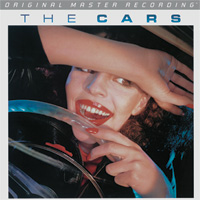
Vinyl Review: The Cars, “The Cars”

The CarsI say this with only a slight bit of embarrassment; The Cars’ debut album is my most-purchased title ever. I received it on vinyl one Christmas (way back when humans licked scum off the rocks for sustenance… 1978?), wore that out, repurchased it a year later, bought the CD at the dawn of the digital era, rebought the Rhino remaster because that initial release was horrid, and finally it has come to this — the Mobile Fidelity half-speed mastered vinyl edition. Can you imagine?

For those who like to geek out on the technical end of things, in the vinyl world a sound source is fed into the machine that lathe-cuts the groove into the metal master disc. It is this disc that subsequent vinyl imprints will be pressed from. For modern vinyl cutting, that source is a digital file and the cutting is in real time, meaning the lathe cuts at the same rate as the song is normally played. Mobile Fidelity, or Mo-Fi as they’ve branded themselves, goes back to the original analog master tape for source material and plays back the tracks at half the speed, thus being able to grab much more audio material, hence the “Half Speed Mastered” headline so famously pasted across the tops of their sleeves.

Does it make a difference? I begrudgingly have to admit that it does, and I say this because I am famously candid on the point that my love for vinyl is strictly irrational. I believe it is equal parts nostalgia, fetish and perhaps an attraction to the “bigness” of the record presentation, and that most of the time the much mentioned “warmth” and clarity of analog is the listener hearing what they want to hear, but not what really is. Yet those first palm-muted guitar plunks of “Good Times Roll” followed by the keyboard pings from Greg Hawkes definitely have something my remastered CD doesn’t, and the creeping fear that I’m becoming another arrogant audiophile has started to settle in.

Setting aside digital media entirely, the original vinyl editions of The Cars were mass-manufactured and, most often, played on really low-end turntables. My first real turntable had an 8-track deck in it, so there you go. The last tracks on either side, “Don’t Cha Stop” and “All Mixed Up” suffered terribly on that inner groove, especially the latter as there was a saxophone solo at the end, and the lack of bass clarity down at the end of a record causes some frequencies to sound thin and tweezy (”Tweezy” is a registered copyright of Dw. Dunphy Made-up Terminologies Ltd.) By using this particular cutting technology, and a grade of vinyl three times thicker than WEA’s standard weight of the time, there is enough guts in the material to take a bass signal. All this is to say that the record sounds fantastic, even on my Sony turntable bought straight off the shelf from Best Buy.

Is this an essential album? From the viewpoint of pop/rock history, absolutely. You know at least 75% of the album already even if you’ve never owned it. Is this an essential version? Only if you’re a vinyl nerd or a dedicated fan of the band. At $30+ a pop, this release will run you three times the cost of its predecessors, but if you fall into either of those two categories, you’ll truly appreciate another fine offering from Mobile Fidelity.

Reblog this post [with Zemanta]

Tags: , , , ,

  • Tony S
    "Does it make a difference? I begrudgingly have to admit that it does, and I say this because I am famously candid on the point that my love for vinyl is strictly irrational."

    After years of comparing CD reissues with original vinyl, I don't think you're irrational. There's a spaciousness to the sound of vinyl, plus the very high end comes over better and the bass sounds more natural. I know what you mean about songs at the end of a side sounding crappy -- but not all mastering jobs suffer from that.

    I did a side-by-side with the Beatle reissues, for example, and was seriously disturbed at how much sonic information is NOT on the CDs, like the breaths in "Because" and massive treble on the cymbals in "She Said She Said."

    I love this record too. I always think it's going to be insubstantial, but every time I play it, it surprises me. The compositions are first-rate, and Roy Thomas Baker's production is bold without being garish. You might also enjoy another RTB-produced effort from two years later, Hilly Michaels' "Calling All Girls." Greg Hawkes is featured, and it's got some Cars-like arrangements on it.
  • tangstrom
    When my wife and I were married and our record collections merged, we had this album on LP (2 copies), cassette (straight from Columbia House), 8-track (ditto), and CD. I have since also bought the Deluxe Edition, and have been halfheartedly searching for the reel-to-reel tape, just so I could have it in every conceivable format.

    Now I guess I'll have to save my shekels for this version. I have the Mo-Fi version of the Moody Blues' Long Distance Voyager, and it really does make a difference, even on my circa-1983 Technics direct-drive turntable.

    Also, the album is indeed essential. There's not one track that makes me think, "I think I'll skip this one."
  • Russ
    I bought the original LP about a month after it came out. The thinnest commercial record I ever bought outside of an RCA Dynaflex LP. I could literally bend the record across the diameter to make the two ends meet. It didn't fall limply into your hands like a Dynaflex, and it did sound better. Barely banded so trying to play a single track meant scratching it like crazy. New band + rampant inflation = WEA Cheapo Treatment. Don't know if later pressings were better or not, but I'm sure they wouldn't be as good as the MoFi. Might be worth buying just for Moving In Stereo/All Mixed Up.
  • You did not identify your vinyl gear. Mine is pretty modest and outdated by modern audiophile standards. Ariston RD-11s table, looks like a Linn but I'm sure does not sound as good. The platter seems to weigh about 7 lbs, though. Mayware unipivot tonearm. Audio Technica ML440 cartridge.

    Last week I dusted off my turntable and played vinyl for the first time in two years. It was sort of humbling, because it made the CDs and MP3s I've been listening to lately sound second-rate. Mainly, I was a bit disappointed with the Beatles remasters, and decided that in the end, I will have to transfer my friend's vintage (but mint condition) Beatles Blue Box to CD for my stereo Beatles reference. Spaciousness? Yes, I suppose so, but what I notice is the dynamic immediacy of plucked strings and snare drum hits, and more detail from the midrange on on up. But then there are the warps, and bad pressings, and off-center LPs. Vinyl is maddening because its potential is so often unrealized. Mo-Fi usually hits the mark, though.
  • J
    I doubt I'd plunk down the $$ for this version, but crap, this album takes me back to a very specific time and place. It was on heavy rotation in 1984, when I had my first *serious* boyfriend, and the world was full of opportunities and freedom. Sigh. Any song off of it brings me right back.
  • Eric S.
    Essential album; Maybe in my Top Ten of all time. My biggest revelation with this album was getting the deluxe CD reissue and listening to the original demos. The great songs were always there, but I was amazed what was added through Roy Thomas Baker's production. It took what would have been a good album and made it a great album. I rarely listen to vinyl anymore, so I guess I won't know what I'm missing. But, it certainly is a deserving album for this kind of treatment.
  • Old_Davy
    Mo-Fi's are great, second only to Japanese WEA releases. For a real treat, get the Japanese vinyl of "Trick Of The Tail" by Genesis. Talk about bass response. WHOO-BOY!

    $30 is probably about right in line for one of these Mo-Fi's. Back in the 70's when they first came out, they were double the price of a regular album - $15. If you can find a copy of "Crime of the Century" by Supertramp, take my advice and buy that baby right away!

    I'm not so convinced it is the half-speed mastering that makes them sound so good as it is the pure vinyl they use. Hold it up to the light, you can see through the black vinyl. Cool!
blog comments powered by Disqus