

 Summer movies: Lilo & Stitch, Superman, and The Fantastic Four. Summer Off Broadway: Toxic masculinity. The vibes are everywhere. Abby Rosebrock’s Lowcountry, at the Atlantic, was about a kindly sex offender and his would-be girlfriend and/or “fucked-up mystic,” both their lives deformed since adolescence by Christianity wielded punitively along South Carolina’s marshy coastland. It was a baffling neo-noir comedy of sorts that I found more exasperating than engaging, with a particularly wonky ending. But two other shows exploring the world of men gone astray, Penelope Skinner’s Angry Alan and Emmanuelle Mattana’s Trophy Boys, are more persuasive.
Mattana’s play, a lively 75 minutes at the MCC Theater, hails from Australia, but the themes are universal. (A reference to mayoral candidate Zohran Mamdani situates the show, which has been on the road since 2022, in NYC 2025 for its U.S. premiere.) We’re in a wealthy prep school and embedded with a male debate team facing off against the girls for a final cutthroat competition. The four boys have an hour to put together an affirmative answer to a contentious question: has feminism failed women? Schooled in woke, they’re initially thrown by the topic, embarrassed to defend the patriarchy. Still they grapple with it, satirically, and concepts like “intersectionality” and “neo-capitalist colonial systems” are skewered in arrogant teen-speak. Then, a shift, as one of them is accused of sexual assault, and additional revelations tumble like dominoes.
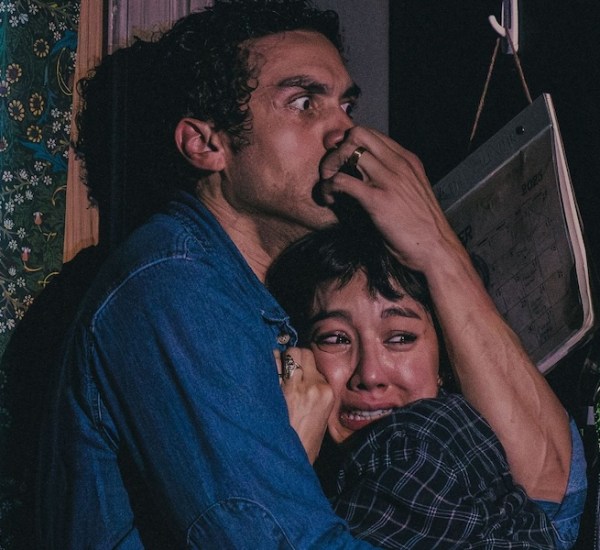
Trophy Boys is the latest “teens in trouble” show directed by Danya Taymor, of the Broadway hits The Outsiders and John Proctor is the Villain, where a classroom is upended by a close reading of Arthur Miller’s witch hunt play The Crucible that hits uncomfortably close to the bone. Subtle it isn’t, as “allyship” is thrown out the window once a questionable coverup is shakily agreed upon, and the performers, including Mattana, manically make a meal of their hypocrisy. Wait, the playwright is one of the boys? Indeed, as per her instructions all four roles must be played by female, queer, trans, and nonbinary actors. They’re very good, stalking the intimate classroom set (by Matt Saunders, and decorated with posters of “inspirations” like Oprah Winfrey and Yoko Ono), but it struck me as an affectation…until a devastatingly quiet scene, where the POV changes and a pall falls over the fun and games. Chilling.
The British Skinner’s play (co-created with Don Mackay for the Edinburgh Fringe Festival in 2018) is the debut offering of Studio Seaview, in Second Stage’s from Off Broadway digs. Sweetening difficult subject matter is star John Krasinski, the once and forever Jim Halpert from The Office. He’s not the title character–when was the sheepishly appealing Jim ever angry? But, as Roger, sliding down the slippery slope of online hucksterism, he can’t help but suggest a Jim who has broken bad. Not that he seems to know it, or show it; in this one-person show he exudes self-confidence, and ingratiates us into his suburban life. It’s not great; a broken marriage, a problem son, a new girlfriend, job loss.
But he’s chipper. Roger’s life is dominated by the title character, a popular (and unseen) manosphere influencer, who has an answer for everything, usually involving the “gynocracy.” The more he (literally) buys into Alan’s misogynistic vision, the more poisoned he becomes. But Krasinski plays Roger’s descent as a full-throated liberation, a freedom he encourages his son to share in. As directed by Sam Gold it’s a broad performance, reminiscent of one of Bruce Dern’s movie psychos in the Seventies when Roger is at his worst and most messianic speaking the gospel of Alan. Crucially, though, it’s also empathetic, as the increasingly desperate Roger wanders in and out of the environments within dots’ turntable set, most memorably an Alan convention attended by a couple of mannequins. The show also makes fine, incisive use of video to depict Roger’s terminal online-ness, as in Eureka Day. In a powerful twist his predicament becomes flesh and blood, and words fail him at a crucial moment when he needs to be present in his life. Anger can only get troubled men, and boys, so far.


Comments