

That title above is incendiary. Let’s put it a different way: Showtime was RC Cola and HBO was both Coke AND Pepsi.
Showtime was perfectly happy to air shows that were almost good and try to pass them off as prestige TV.
Let’s try not to make this too much about my opinion (though that’s gonna happen here) and let’s not let the sheer volume of iconic HBO shows totally overwhelm everything Showtime ever did. Let’s start by looking at Variety’s list of the 100 Greatest TV Shows of All Time:
Variety cites 13 HBO shows, two Showtime shows, and that second Showtime entry depends on counting Twin Peaks: The Return when it cited Twin Peaks. That’s a loud disparity between two premium-cable networks competing for much of the same audience; and the further we dig into their histories, the comparison gets even worse.
Showtime wasn’t an underfunded also-ran. It had talent, money, recognizable stars, a marketing department, and shows that attracted substantial audiences.
My question here isn’t why Showtime made bad television. It’s why they were so content to make television that plateaued at almost great. It’s as if they were shows that could have been great on HBO, but actually implemented network notes.
It’s Not TV, It’s HBO
HBO’s defining series weren’t simply popular dramas with swearing, sex, and violence. They were shows that changed what television could do.
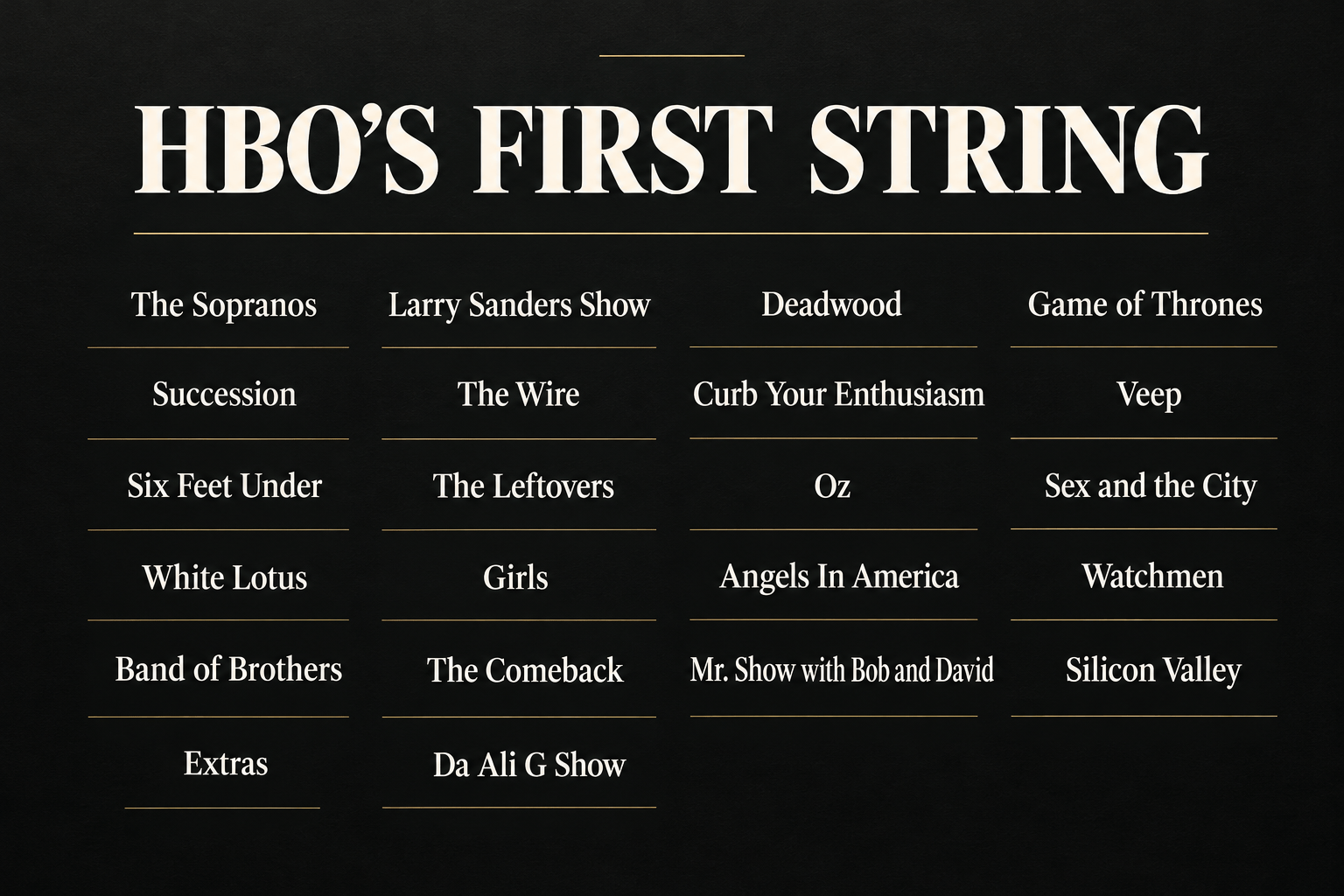
Early on in the history of cable (aka the 1980s), yeah, nudity and swearing was a titillating novelty. Early HBO with Dream On and 1st & Ten were pretty weak – while Showtime’s Steambath was even more transparent, sexually. But by the time Garry Shandling moved from It’s Garry Shandling’s Show on Showtime in the late 80s to The Larry Sanders Show in 1992 and HBO dropped Tanner ‘88, Mr. Show with Bob and David, and Oz – let’s just say if this competition was a prizefight, they would have stopped it right there.
The Sopranos made a monstrous, charismatic protagonist the center of an examination of American life. The Wire made the institutions of an entire city into societal criticism each season. Deadwood turned a Western into a brutal, profane poem about civilization. Six Feet Under used a family funeral business to examine mortality.
Later came Succession, Chernobyl, Watchmen, The Leftovers, Veep, and others that pursued very different ideas with very different styles.
The point isn’t that every single HBO show was a masterpiece. It’s that the network built a catalog of work that felt ambitious and fully realized. It absolutely owned cable drama, comedy and miniseries.
HBO also had the institutional reputation and creative relationships to let shows be difficult, strange, or uncomfortable without automatically making them more conventional. Key HBO executives Michael Fuchs, Chris Albrecht and Carolyn Strauss deserve a lot of credit for establishing a culture that put a premium on creative freedom for their showrunners. (If you’re interested in the company’s history and how this happened, check out James Andrew Miller’s book, Tinderbox.)
By comparison, Showtime often seemed satisfied with a series that had a great premise, a good cast, and enough entertaining material to keep the audience watching.
The Poor Man’s ______
Too often, when Showtime and HBO series tackled similar subject matter, it gets pretty easy to say, “Billions is the poor man’s Succession.”
- The Wire > The Chi: One builds an expansive portrait of institutions and a city; the other offers a more conventional neighborhood drama. The shows are hardly identical, and this is unfair to a very good The Chi to compare it to what is arguably the best series in TV history.
- Getting On > Nurse Jackie: Both use healthcare as a setting for dark comedy and difficult characters. Getting On is stranger, more uncomfortable, and less interested in making its characters conventionally appealing.
- Succession > Billions: Both feature wealthy, ruthless people and battles for power. Succession somehow combines social commentary, the darkest of comedy, Veep-worthy insults and compelling drama that never jumped the shark; Billions often seems content to be a soap opera about rich people, or feature corporate-jet porn.
- The Comeback > Episodes: Both feature former Friends stars and both satirize television and celebrity. The Comeback is painfully specific about humiliation and show business; Episodes gives the same topics a good effort.
Showtime repeatedly found material in the same general territory as HBO’s best work, but its versions often felt less adventurous, rough edges sanded off, or less sure of what they wanted to say. Again, not bad. Just not as good.
Did Anybody Get the Point of Tony Soprano?
After The Sopranos, premium cable loved to embrace morally compromised protagonists.
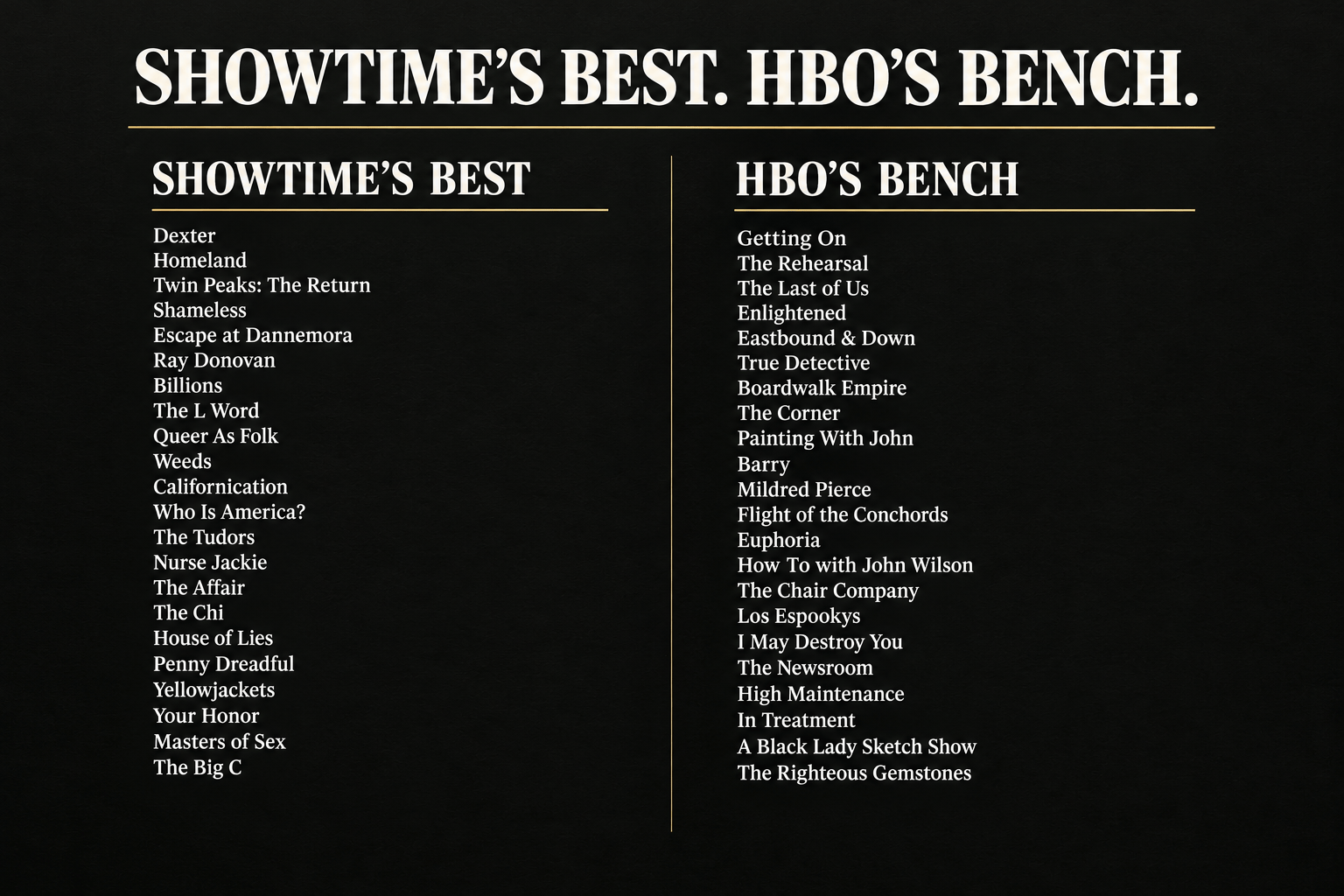
Showtime’s lineup included Dexter, Nurse Jackie, Ray Donovan, Californication, Shameless, and Homeland. These shows often understood that damaged, dishonest, selfish people make good TV. But did they consistently understand what made those people compelling?
David Chase didn’t need to pretend Tony Soprano was secretly a good man. Tony’s charm, humor and devotion to family made his ugliness more revealing. He never seemed confused that Tony was an awful human being – even though his audience might have missed it
With Showtime’s antiheroes, when I watch Nurse Jackie or Homeland, I don’t get the sense that the writers and creators even understand their own tone, with characters and perspective bouncing between critical and forgiving throughout their runs. HBO and David Chase knew that The Sopranos was. I’m not sure that Showtime did.
Jumping A Shark
I need to remind you that I’m not trying to say everything on Showtime sucked. It didn’t. I just found it frustrating how they could start with a great premise and just make a good show.
The one that drives me crazy is Dexter, the show people often cite as Showtime’s prestige TV. The original premise was that a serial killer with no emotions could pass for a human being. First season? Great! Then he got a girlfriend and feelings. The series increasingly became a run-of-the-mill thriller about keeping Dexter out of trouble.
Homeland’s first season told a story with a natural endpoint. Continuing the series meant finding new and sillier reasons to sustain its central characters and conflicts.
Nancy Botwin’s suburban drug-dealing on Weeds had a fun premise and a good first few seasons. The show continued long after the original setup had delivered its most interesting consequences.
These weren’t necessarily bad shows from the beginning. But Showtime was often willing to keep going after things were getting tired. Not that HBO didn’t do that with the late season groanfest of Entourage – but usually HBO knew when to make an exit.
HBO’s Failures Could Still Be Noble
HBO wasn’t immune to shallow, derivative, or overextended television.
Ballers, Hung, Arli$$ are not HBO’s best and brightest. Entourage, especially near the end as they circled the drain, was lazy; sounded like 55-year-old screenwriters typing to me. Tell Me You Love Me managed to make sex and nudity boring.
Westworld is almost the perfect Showtime phenomenon I’m describing almost-great television.
Rome was an expensive failure – and the inventor of “sexposition” (describing plot points while nude).
Even HBO misfires such as Vinyl and Luck could be more interesting than some of Showtime’s biggest successes. Both were ambitious with great creative pedigrees. Vinyl was too expensive, but damn good; although they won several Cokie Awards (my tribute to over-the-top cocaine snorting). Luck was a great David Milch racetrack series just getting going when it was canceled after a couple of horses died during production.
It’s not that HBO never settled. It’s that HBO’s lesser shows existed alongside a deep catalog of work that felt singular and fully realized. And I contend that lots of these mediocre HBO shows would have been lionized as Showtime’s best if they aired there.
Showtime’s Genuine Strengths
Here’s the exception that proves the rule: Twin Peaks: The Return. It was a Showtime show, which might be easy to forget in the streaming era as Showtime was biting the dust.
Twin Peaks: The Return is one of the most stubbornly plot-resistant shows I’ve ever seen. Watching it is like being in a museum looking at a painting you love but don’t understand. In fact, there’s a scene in the mysterious high rise watching a box that openly explores the act of watching television. David Lynch works are beautiful, impenetrable puzzles and Twin Peaks: The Return is no exception. The midseason black-and-white episode “Gotta Light?” with the Woodsmen is probably the most defiantly odd hour to ever air on TV.
I’ve made the claim that Showtime feels like prestige TV that succumbed to network executive notes. But there’s no way in hell that any Showtime executive got his or her hands on Twin Peaks: The Return. It’s pure, uncut David Lynch.
The question arises whether Showtime was more comfortable granting extraordinary freedom to an established auteur than taking comparable risks with other talented creators. Lynch is famous, so he gets a different treatment.
The network had other genuine accomplishments:
- Queer as Folk and The L Word gave Showtime a distinctive LGBTQ programming lane, serving audiences that mainstream television had often neglected.
- Escape at Dannemora was a genuinely excellent limited series.
- Showtime’s relationship with Sacha Baron Cohen produced Who Is America?, while HBO had Da Ali G Show. That’s a useful tie rather than another comparative HBO “win”
Showtime wasn’t incapable of greatness. It just wasn’t that often.
Other Comparisons Aren’t Fair
I mentioned the great Showtime limited series Escape at Dannemora as a success, and it was. But if we’re going to get into miniseries, some of HBO’s most notable are considered the best things TV has ever produced: Angels in America, Watchmenl, Chernobyl, Band of Brothers, Mildred Pierce, The Corner and several others.
HBO dominated the world of stand-up comedy specials. HBO has successful shows like Last Week with John Oliver and Real Time with Bill Maher.
For years, HBO has had a live sports presence with tennis and boxing, plus their sports documentaries.
Their overall proposition is so much more complete than Showtime, that it’s created a situation where HBO has always been Goliath to Showtime’s David.
All of that said, I can’t possibly imagine a person subscribing to Showtime and not HBO. That would be the “stupid” person in this article’s title.
But did all of these successes arm HBO executives with more resources and the safety net of a larger subscriber base?
The Willingness to Settle
Showtime had resources, talent, audiences, and enough genuinely good shows to demonstrate what it could do.
And yet sometimes the sum of the parts could add up to zero. I’ve got to turn my cards over here: I thought both The Affair and Your Honor were embarrassments despite the people involved. The Affair could have been a Lifetime movie and Your Honor had all of the grittiness and crime-savvy of an episode of Matlock. And Californication is like an adolescent wish-fulfillment fantasy of a middling screenwriter.
But I’m not here to dunk on Showtime’s worst, and I’m not at all saying that I never liked a Showtime show.
Too often Showtime accepted the derivative, the overextended, or almost clever when it had the ingredients for something more ambitious. Showtime often seemed content to deliver a version of television that looked like prestige TV without requiring all of that pesky quality.
HBO’s advantage wasn’t perfection or any one particular show. It was the depth of its lineup quality over the years.
Showtime wasn’t HBO for stupid people because its viewers were stupid. It was HBO for stupid people because the network too often treated the audience as though almost great was good enough.


Comments