

 The foreclosure signs are up at the St. James Theatre, as The Queen of Versailles announced its final performance on Jan. 4 after a run of about two months and an estimated $22 million down the drain. What happened to the most highly touted new musical of the Broadway season? Let’s break it down before the movers arrive.
It starts, and ends, with unappealing “‘best people'” subject matter. Trump is always touting how he’s staffed his cabinet with keen-minded professionals with America’s best interests at heart…but they always come up short, one dopey narcissist after another feeding at the MAGA trough. Based on the 2012 documentary The Queen of Versailles, the reunion of Wicked composer Stephen Schwartz and OG (Original Glinda) Kristin Chenoweth tries very hard to convince us of protagonist Jackie Siegel’s better angels…but it, too, comes up short. The rise, fall, and rise again of a hard-luck shopaholic and Lifestyles of the Rich and Famous addict who had the good fortune to second-marry “timeshare king” David Siegel (I never miss an F. Murray Abraham musical!), presided over their building the largest, French-modeled home in America in a Florida backwater, and persevered through the 2008 financial crisis to carry on constructing has no moral to share, no wisdom to impart, nothing. Jackie’s rampant consumerism destroys her sensitive daughter from her troubled first marriage, she sets up a foundation in her honor, and…nada, back to the as-yet-unfinished, Sisyphean-seeming, totally Trumpian task of putting up a 90,000-sq. ft. faux Versailles, one with a roller rink and bowling alley, in the sticks and swamps. A good producer might have suggested ending where the film ends, in limbo, with an ironic postscript explaining the Siegels’ changing fortunes. (The much older David died earlier this year.) But with Jackie Siegel as one of the producers a happier ending was called for, however schizophrenic and unfeeling she comes across.
Good tunes, good design, something, might have saved it. With material (book by Lindsey Ferrentino, a playwright unknown to me) that lacks the psychological acuity or quirky eccentricity of, say, the equally housebound Grey Gardens, Schwartz feeds a lot of “I want” songs to his star, who makes a vocal feast of them but can’t get them to resonate. (Nothing against the esteemed composer but only a Sondheim or Kander and Ebb might have gotten Jackie’s number, and gone for the jugular with something more acrid and acidic…if she didn’t overrule it.) Chenoweth is the center of Siegel’s vacuum, where bad publicity is better than no publicity at all, and not much else. Abraham, a good sport tasked to do little, croaks a song or two agreeably; our attention soon wanders, then shifts, from their fundamentally uninteresting power couple to Nina White, poignant singing the agonizing “Pretty Wins” as the doomed Victoria, and Tatum Grace Hopkins as her opposite, Jackie’s niece, the bedazzled Jonquil, who has a rousing number called “I Could Get Used to This.” The contrast is striking, and a good producer might say “there’s the show!” (But, Jackie.) Director Michael Arden, so sure-footed with Maybe Happy Ending and the Parade revival, has a concept of occasionally switching over to the French aristocracy as a counterpoint to the main action but no plan to make it meaningful, and Christian Cowan’s costumes (think Bob Mackie without the humor) and Dane Laffrey’s scenic and video design are suitably, if unremarkably, vulgar. Jackie’s dog is good and will survive to bark again. As for The Queen of Versailles–this property is condemned.
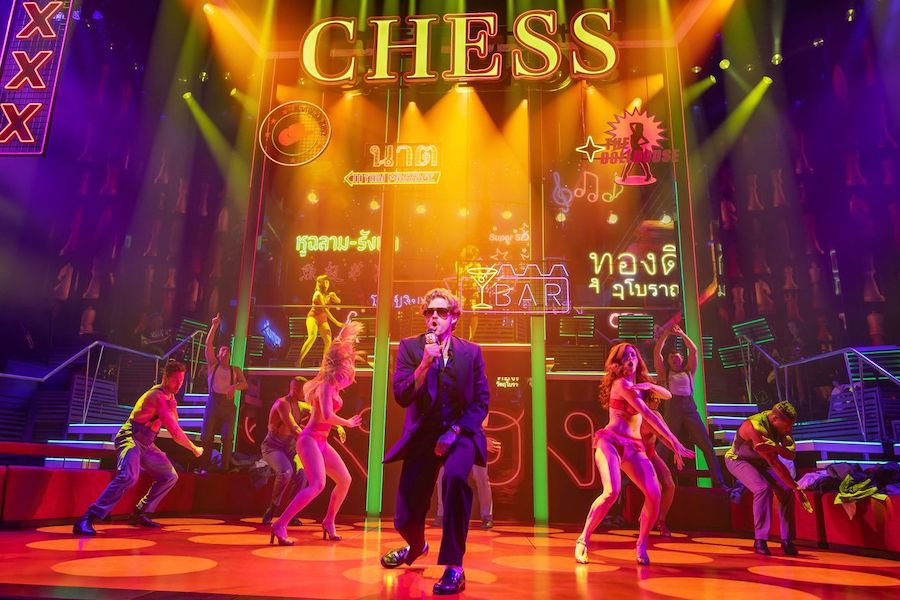 Chess is less a revival than a problem to be solved. Tim Rice and Andrew Lloyd Webber saw their concept albums for Jesus Christ Superstar and Evita hit pay dirt as actual musicals and movies; Rice (lyrics) and the ABBA guys, Benny Andersson and Björn Ulvaeus (music), had a smash with the radio-friendly earworm “One Night in Bangkok” in 1984 but Rice’s battle between American and Soviet grandmasters modeled on Bobby Fischer and Boris Spassky was lost on Broadway in 1988. Subsequent productions and recordings after that Main Stem flop however showed it had a few moves left to play. And now a showy revival, with a new book by screenwriter Danny Strong (of Dopesick and Game Change), attractive leads, a pop design, the works…except, it doesn’t work.
No, not the music, which also includes another standard, “I Know Him So Well.” But you have to wade through a full act of incomprehensible gobbledygook to get to “Bangkok” and that. In Chess…no, I can’t, I can’t even with the book of Chess, which has only gotten worse with revision. There’s an ugly American chess star, Freddie Trumper (Aaron Tveit), his hapless girlfriend and advisor, Florence (Lea Michele), an Iron Curtain refugee, and Freddie’s opposite number and opponent, Anatoly (Nicholas Christopher), who suffers (and suffers, and suffers) nobly but is also no prize, having given up his life and wife, Svetlana (Hannah Cruz), and family, for chess. Various handlers orchestrate their actions as the nuclear menace intrudes, the world collapses around them, and Florence changes alliances (the bigger deal, of course). Each character has exactly one shade of resentment to play, and the fine director Michael Mayer (Spring Awakening, A Beautiful Noise), flummoxed by what to do, mostly has them pivot to center stage (David Rockwell’s concert riser set also lacks inspiration) and belt their numbers. The chrome-domed Christopher, ready for The King and I and/or The Yul Brynner Story, socks it across the best and gives Ragtime‘s Joshua Henry a run for his money, closing Act I with the vocal TKO “Anthem.” (Which like all the songs is pitted against the muddy sound design at the Imperial.)
Florence is a lame role as she pivots from one lousy guy to the other and Michele, a true Broadway baby since the original Les Misérables, doesn’t (or can’t) bring much to it other than her Glee starpower. (Cruz fares better but has less to do as the world-weary Svetlana, appearing only in the second act.) Tveit’s Freddie, a fatuous “best person,” would be the worst character up there, and fatally for the actor he doesn’t get much going for the flatly staged “Bangkok,” which fails to open Act II with a bang. The tighty-whities he hops into during the song do some of the work for him but nothing can disguise how utterly naked the usually excellent Bryce Pinkham is. As “The Arbiter” of the chess matches the performer has been given terrible material that sends up the Cold War and Freddie’s last name (why not just change it?) and puts the dated show on the defensive from his first lines. He’s meant to provide some relief from the self-serious monotony of the rest of Chess (all three hours of it) but I cringed whenever he appeared. I’m glad Chess cultists are getting a chance to see it but I think they’d agree it was much better served as a double LP than as this checkmated production.


Comments