
Once upon a time, fashioning an action epic movie took more than just a big budget — it required some real imagination, not just to come up with the ideas for the storylines, but to figure out how to bring larger-than-life situations to life onscreen. The results were often laughable, but just as often, they introduced some real visual thrills and filmmaking innovations — stuff that really made you wonder how it was made. These days, all the world’s a digital playground, and although filmgoers can still be dazzled by CGI-fueled stuff like Roland Emmerich’s upcoming 2012 or James Cameron’s Avatar, we’re a lot more jaded now; as incredible as things can look, we know, in the back of our minds, that it was produced with more mouse-clicking than elbow grease. Action movies, in particular, seem to have devolved; technology definitely helped to a point, but they’re often built from such simple materials that anything that speeds up their journey to the screen feels like a net loss.
That’s how I felt, anyway, as I watched the new Blu-ray transfers of Logan’s Run (1976), Heat (1995), and Tony Scott’s remake of The Taking of Pelham 123 (2009).
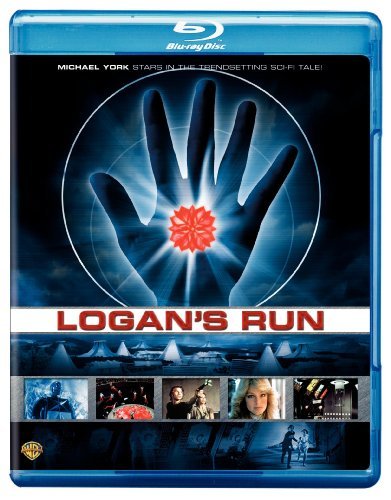 I’ve never understood why Logan’s Run, directed by Michael Anderson and adapted by David Zelag Goodman from the William F. Nolan/George Clayton Johnson novel, isn’t regarded as one of the worst sci-fi movies of all time. It takes a marvelous premise — in a postapocalyptic world, humans have retreated into domed cities where life is one big party until your 30th birthday, when you’re executed en masse for public amusement — and pisses it away in a grotesque orgy of bad acting, hokey special effects, and flimsy-looking sets. The story revolves around Logan 5, a member of the police force (or “Sandmen”) tasked with hunting down anyone who decides to take a hike rather than submit to the “Carousel,” a Roman Colisseum-like arena where the 30th birthday boys and girls are sucked into a vortex and blown up (or “renewed,” as they call it) while onlookers cheer. After discovering an ankh among the personal effects of one eliminated “runner,” Logan takes it to his city’s central computer, where he learns it’s a symbol of an underground resistance movement; the computer directs him to infiltrate the movement, and mucks with Logan’s lifeclock (a lighted jewel embedded in every resident’s palm) to make it look like he’s approaching his date with “renewal.” Unfortunately, the computer doesn’t tell anyone else what it’s done, so Logan becomes an unwilling de facto runner — thus setting in motion, um, Logan’s run.
As I said, it’s really a cool premise for a story; unfortunately, everything about Logan’s Run screams bargain basement, from the ersatz, stucco-ridden futuristic city, which looks like nothing so much as an abandoned mall, to the cheesy laser holograph special effects, to Michael York’s stunningly bad performance in the title role. It’s hard to blame York too much for his woodenness here — you try running around in silver and black pajamas while pretending to fire a laser gun at people in silly tunics, and see how convincing you are — and really, in terms of acting, he’s one of the best things about the movie. Taken in context, however, that statement doesn’t mean much; even if York isn’t as painful to watch as, say, Farrah Fawcett (playing the dumbest freedom fighter in the history of film), he still isn’t enough to overcome scenes like the one where he and Jenny Agutter battle a laughably fake robot in a snow cave that looks like it was borrowed from a high school production of Rudolph the Red-Nosed Reindeer. Logan’s Run strains for meaning, but it wavers between boring and unintentionally funny, and the transition to Blu-ray doesn’t do the movie any favors, either: the cut scenes that are supposed to depict the movie’s domed metropolis look more like low-budget models than ever, and the special effects (“the screen’s first use of laser holography!”) don’t benefit from added visual clarity. As distasteful as Hollywood’s current lust for remakes might be, this is one case where revisiting the source material might actually produce a better film. (Bonus features consist of a vintage featurette, a trailer, and a commentary track featuring York, Anderson, and costume designer Bill Thomas, who somehow escapes 118 minutes of merciless ribbing.)
[kml_flashembed movie="http://www.youtube.com/v/4WUUnc1M0TA" width="600" height="344" allowfullscreen="true" fvars="fs=1" /]
![513yGAAhI9L._SCLZZZZZZZ_[1]](https://popdose.com/wp-content/uploads/513yGAAhI9L._SCLZZZZZZZ_1.jpg "513yGAAhI9L._SCLZZZZZZZ_[1]") Fast forward 19 years to Heat, which represents a uniquely wonderful convergence of a filmmaker deep in his element, a truly wonderful script with a cast to match, and technology being used as a subtle yet effective tool rather than a smothering device. Now this, people, is how you make an action movie: At 170 minutes, Heat should feel bloated and heavy, but it’s light and lean, with no wasted moments and no superfluous parts. Of course, Mann had the advantage of working with Pacino and De Niro, but if you were one of the unlucky souls who witnessed the horror of last year’s Righteous Kill, you know that just having those two on set doesn’t guarantee a watchable movie. You need a real script, and Mann’s is a doozy.
Fast forward 19 years to Heat, which represents a uniquely wonderful convergence of a filmmaker deep in his element, a truly wonderful script with a cast to match, and technology being used as a subtle yet effective tool rather than a smothering device. Now this, people, is how you make an action movie: At 170 minutes, Heat should feel bloated and heavy, but it’s light and lean, with no wasted moments and no superfluous parts. Of course, Mann had the advantage of working with Pacino and De Niro, but if you were one of the unlucky souls who witnessed the horror of last year’s Righteous Kill, you know that just having those two on set doesn’t guarantee a watchable movie. You need a real script, and Mann’s is a doozy.
Pacino and De Niro star, respectively, as LAPD detective Vincent Hanna and career thief Neil McCauley, and their conflict — mostly carried out by proxies — is the fuel that moves Heat. Mann isn’t done there, though; what he takes pains to establish, sometimes very heavy-handedly, is how similar Hanna and McCauley really are. Not that McCauley is secretly a classy guy and Hanna is a sociopath, but that they’ve both sacrified their lives to their careers, and it’s that shared discipline that each responds to in the other. De Niro and Pacino famously only shared a couple of scenes in Heat, and by keeping them apart for so long, Mann ensured that their chummy tete a tete in a coffee shop would act as the dramatic hinge for a movie that features an epic shootout on the streets of Los Angeles.
Heat contains plenty of gunplay and other assorted violence, but Mann doles it out in chunks; unlike, say, Bad Boys — which also came out in 1995 — the action is merely part of the story, rather than the movie’s entire reason for being. And on top of all that, it’s seriously easy on the eyes. Mann has always been skilled at using urban landscapes as their own characters, particularly at night, and I don’t think he — or maybe anyone else — has ever made better use of Los Angeles. His camera glides over fluorescent-lit, crowded freeways, lingers over concrete and glass, plunges into seedy neighborhoods on the wrong side of the tracks. He makes brilliant use of light and darkness throughout, bringing that contrast to a head with the movie’s brilliantly filmed climax. Insofar as you can ever say this about any movie starring Pacino, Heat is subtle — where it counts, anyway, and not always where you expect it.
Heat‘s 1080p transfer isn’t as perfect as the film itself, but it comes close. Although it struggles with some of the darker scenes and is subject to some noticeable shifts in contrast and brightness, overall, the disc looks tremendous, taking full advantage of Mann’s love for cold artificial light, hard lines, and pure, inky blacks. During the VHS era, it was one of those movies that cried out for DVD, and it looks even better here. Near as I can tell, pretty much all of the bonus features have been ported over from the double-disc special edition Warners released in 2005, but at least there are a lot of them, including five documentaries, a ton of additional scenes, trailers, and a commentary track from Mann. Currently going for $16.49 at Amazon, the Heat Blu-ray isn’t exactly essential unless you don’t already own some version of the movie, in which case it’s a steal.
[kml_flashembed movie="http://www.youtube.com/v/LlV32_lo4-c" width="600" height="344" allowfullscreen="true" fvars="fs=1" /]
![51pgG2qpP7L._SCLZZZZZZZ_[1]](https://popdose.com/wp-content/uploads/51pgG2qpP7L._SCLZZZZZZZ_1.jpg "51pgG2qpP7L._SCLZZZZZZZ_[1]") And speaking of “steal,” here’s Tony Scott’s heist thriller The Taking of Pelham 123 (also available on DVD, Video on Demand, and UMD for PSP). A needless remake of Joseph Sargent’s 1974 adaptation of the Morton Freedgood novel, Scott’s Pelham sets itself apart with the title, which boils Sargent’s One Two Three down to numbers — and also boils the original’s sticky, grime-soaked aesthetic, leaving behind just another sleek, noisy thrill ride that loves its freeze frames, jump cuts, and cable news-worthy sound effects (text repeatedly pops up onscreen, always accompanied by a techno thunk) more than its characters. Which is a shame, because Scott had some fine actors to work with, including John Travolta as the scenery-chewing heavy, Luis Guzman as his main accomplice, John Turturro as a cop, James Gandolfini as the mayor of New York City, and Denzel Washington as the beleaguered dispatcher who’s forced into their orbit when Travolta and Guzman’s gang hijacks a subway train. It all goes down smoothly enough, and it’s fairly entertaining for what it is, but for more than a few of its 106 minutes, 123 feels like a quickly Xeroxed version of Die Hard with a Vengeance, and given how often people give me crap for thinking that’s a halfway decent action flick…well, you get the idea.
And speaking of “steal,” here’s Tony Scott’s heist thriller The Taking of Pelham 123 (also available on DVD, Video on Demand, and UMD for PSP). A needless remake of Joseph Sargent’s 1974 adaptation of the Morton Freedgood novel, Scott’s Pelham sets itself apart with the title, which boils Sargent’s One Two Three down to numbers — and also boils the original’s sticky, grime-soaked aesthetic, leaving behind just another sleek, noisy thrill ride that loves its freeze frames, jump cuts, and cable news-worthy sound effects (text repeatedly pops up onscreen, always accompanied by a techno thunk) more than its characters. Which is a shame, because Scott had some fine actors to work with, including John Travolta as the scenery-chewing heavy, Luis Guzman as his main accomplice, John Turturro as a cop, James Gandolfini as the mayor of New York City, and Denzel Washington as the beleaguered dispatcher who’s forced into their orbit when Travolta and Guzman’s gang hijacks a subway train. It all goes down smoothly enough, and it’s fairly entertaining for what it is, but for more than a few of its 106 minutes, 123 feels like a quickly Xeroxed version of Die Hard with a Vengeance, and given how often people give me crap for thinking that’s a halfway decent action flick…well, you get the idea.
It lacks a soul, or even a reason to exist, but like most noisy and inane modern action thrillers, The Taking of Pelham 123 at least looks great — and never more so than on this transfer, which lets you see every gray hair in Washington’s goatee and pumps up the soundtrack until you’re practically sitting on the tracks as the hijacked train goes barreling down the tracks. Sony deserves credit, I suppose, for taking full advantage of the Blu-ray format, not just with Pelham‘s video and audio, but through a stack of bonus content that includes Cinechat and MovieIQ capability, along with a pair of commentary tracks (one from Scott, one from writer Brian Helgeland and producer Todd Black) and a handful of featurettes. No one in the world needs to own it, but if you’re looking to give your home theater a little rental workout, you could do a lot worse.
[kml_flashembed movie="http://www.youtube.com/v/2VZvwJDOZDo" width="600" height="344" allowfullscreen="true" fvars="fs=1" /]
![Reblog this post [with Zemanta]](http://img.zemanta.com/reblog_e.png?x-id=0a3449c9-fb63-4356-a754-2002de1ca9da)


Comments