
Let me begin by stating that 1988’sÁ‚ Die Hard was my choice for Best Picture that year (with all due apologies to Rain Man Á¢€” a great film, but not as great as Die Hard). The fact that it wasn’t even nominated is yet another example in the endless line of Oscar fuckups, if you ask me. When I got my first laserdisc player in ’89, the very first disc I bought was Fox’s “special widescreen edition” of the film.
 I saw Die Hard on opening weekend at San Francisco’s Coronet theater, which is sadly no more. I was so pumped after it was over that I decided to walk the entire 20 blocks back home. A friend even offered me a ride, but I didn’t take it. I was on one of those “good movie” highs: my adrenaline was jacked up, and I needed to take in what I’d just seen and walk it all off.
It’s funny, because I went into Die Hard thinking it wasn’t going to be that great Á¢€” the “It’ll blow you through the back wall of the theater” tagline was a little on the lame side (even though it turned out to be accurate), plus Bruce Willis was good on Moonlighting, but somehow it was difficult for me to picture him in a feature film as an action hero.
Shows how much I knew.Á‚ And it occurred to me once, while watching the old laserdisc, that the first 17 minutes of Die Hard are so good, it would still be a great film even if Hans Gruber (Alan Rickman) and company didn’t show up.
Willis plays John McClane, a New York cop who’s just arrived in Los Angeles on Christmas Eve as the film begins. He’s estranged from his wife, Holly (Bonnie Bedelia), who moved to the west coast for a new job a few months earlier, taking their two kids with her. A few minutes after the couple are reunited at her office Christmas party, they’re already in an argument: John’s pissed because Holly’s using her maiden name, Gennaro, in her new position Á¢€” vice president of the Nakatomi Corporation. Immediately after their confrontation, he bangs his head softly against the doorway to her executive bathroom and admonishes himself: “That was great, John. Good job. Very mature.” It’s a terrific moment; I could’ve watched an entire movie about these two people trying to reconcile their marriage.
But this is an action film, and soon all hell will break loose when Nakatomi’s employees and their party guests (minus our hero) are taken hostage by a group of terrorists who initially appear to have a political agenda but in fact are after $640 million in bearer bonds stored in the building’s vault.
A couple decades back, director John McTiernan came out with three great films in a row in just under three years: Predator (1987),Á‚ Die Hard, and The Hunt for Red October (1990). His storytelling style truly shines in the latter two, for which he collaborated with cinematographer Jan de Bont, who went on to direct films likeÁ‚ Speed (which is essentially Die Hard on a bus)Á‚ and Twister in the mid-’90s.
The challenge in Die Hard is that given the nature of the story Á¢€” John McClane remains in hiding for most of the movie Á¢€” there are many sequences edited together from different locations inside Nakatomi Plaza (otherwise known as Fox Plaza, in Century City).
Consider the scene in which coked-up slimeball Harry Ellis (Hart Bochner) comes to Gruber with information about McClane. The ensuing conversation takes place between three characters in two different locations: Gruber and Ellis sit across from each other at a desk, while McClane hides from the terrorists in another part of the building. The scene begins with Gruber speaking to McClane via walkie-talkie, and both characters are framed as if they’re facing each other, so it cuts together as a seamless conversation even though they’re in separate rooms. When Gruber hands the walkie-talkie to Ellis, McClane takes a few steps and turns around so that he’s now facing Ellis for their dialogue exchange. This is clearly the work of a director who knew how the final scene would look before he shot a single frame.
Another good example is a sequence early on in the film in which McClane attempts to summon help by setting off a fire alarm: There’s a swish pan from his face to a fire alarm switch. Then we cut to a computer monitor indicating the fire alarm has been triggered. Then another swish pan to a security guard’s face that perfectly matches the speed of the previous swish pan (McTiernan obviously knew these two pieces of film would be cut together). There are several similar moments in The Hunt for Red October thatÁ‚ help to create urgency and tension in scenes that otherwise consist of characters sitting and talking.
Die Hard’s screenplay is credited to Jeb Stuart and Steven E. de Souza, who separately went on to write several ’90s action flicks ranging from great Á¢€” Stuart cowroteÁ‚ The Fugitive (1993) Á¢€” to not so great Á¢€” de Souza gets some of the blame for 1995’s Judge Dredd. One of the great elements of the near perfect script is the relationship between McClane and Sgt. Al Powell (Reginald VelJohnson),Á‚ the one cop on the outside that our hero can trust. A strong bond develops between these two men, yet all of their scenes take place over two-way radio Á¢€” they don’t meet face to face until the very end of the film.
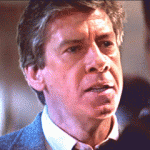 One of my favorite supporting characters is Deputy Police Chief Dwayne T. Robinson, played by everybody’s favorite dickhead principal fromÁ‚ The Breakfast Club, Paul Gleason. Just about every look, every mannerism of this guy cracks me up to no end, like the moment when he looks to the left and to the right after saying sarcastically, “Oh, he claims!” I can’t explain it, but I replay that little moment repeatedly almost every time I watchÁ‚ Die Hard.
But as far as acting goes, let’s be real here Á¢€” Alan Rickman tears this shit right up, creating one of the most frightening and intelligent movie bad guys ever (placing 46th on the American Film Institute’s “Heroes and Villains” list in 2003, in fact). The cat-and-mouse game between Gruber and McClane is tremendous fun, especially the scene in which McClane finds Gruber snooping around on the top floors of the building and the terrorist mastermind instantly shifts to an American accent, pretending to be a partygoer who managed to escape.
Also on hand to tear shit up is composer Michael Kamen, who, starting with 1987’s Lethal Weapon,Á‚ made a good career out of scoring action films well into the ’90s. (He passed away in 2003.) Since our tale takes place on Christmas Eve, Kamen cleverly works sleigh bells into the score along with snippets of “Winter Wonderland,” a little Beethoven’s Ninth, and some “Singin’ in the Rain” for good measure. Kamen’s “Assault on the Tower” cue is an adrenaline-pumping standout (you can hear disguised references to “Singin’ in the Rain” throughout, notably at the very beginning and from 4:08 to 4:11).
[kml_flashembed movie="http://www.youtube.com/v/8RNn2ppfSXk" width="600" height="344" allowfullscreen="true" fvars="fs=1" /]
The legacy of Die Hard is fairly apparent considering the number of ’90s action films that were pitched as “Die Hard in another confined location or on a moving vehicle,” including Speed,Á‚ Passenger 57 (“Die Hard on a plane”),Á‚ Sudden Death (“Die Hard in a hockey rink”),Á‚ Under Siege (“Die Hard on a Navy carrier,” which shouldn’t be confused withÁ‚ Speed 2: Cruise Control, or “Die Hard on a cruise ship”), Under Siege 2: Dark Territory (“Die Hard on a train”),Á‚ or hell, evenÁ‚ Die Hard 2, which was “Die Hard in an airport,” plus it was set once again on Christmas Eve.
Forced to compete with all the copycats of varying quality, the formula was abandoned for the third and fourth Die Hard films — which is one reason why 1995’s Die Hard: With a Vengeance and 2007’s Live Free or Die Hard will never be on par with the first two.
![Reblog this post [with Zemanta]](http://img.zemanta.com/reblog_e.png?x-id=1cb5b8c6-e47d-4021-a166-a93e410d4c65)


Comments