

Those of you who have been with me since the Jefitoblog days may remember that the old site’s mission statement was “poking pop culture’s soft, white underbelly with a sharp-witted stick.” Although not all (or probably even most) of what I wrote back then fit that description, and although I’ve tried mighty hard to be a more positive writer than said mission statement would suggest, there’s no getting around the fact that I have a real fascination with the mealy, bruised spots in artists’ catalogs. Great albums are great, but bad albums — particularly bad ones nobody bought — are interesting.
It was for that reason that I started the Cutouts Gone Wild! column years ago, and it’s also for that reason that I’ve missed the series ever since the expanding digital reissues market forced me to retire CGW! almost two years ago. So I’m bringing it back, sort of, only this time around, we’re just going to be looking at those bad, interesting records that have been shoved to the back of otherwise mostly respectable discographies, whether they’re in print or not. Think of this new series, somewhat indifferently titled Whoops!, as a sort of inverse cousin to Matthew Bolin’s far too infrequent When Good Albums Happen to Bad People. (Or think of it as an unintentional ripoff of columns like this one, which I swear I knew nothing about until work on Whoops! was well under way.)
The rules of Whoops! are simple: We’ll burrow into the mildewed back catalogs of artists who, if they aren’t exactly rock & roll legends, were at least expected not to screw up too badly. In other words, you can bet we’ll be covering Dylan’s Down in the Groove at some point, but don’t expect to see Paula Abdul’s Head Over Heels. We’ll address the commercial (and, in most cases, artistic) failure of the album in question, hopefully dig up some embarrassing videos, and just generally have fun exhuming some long-buried mistakes.
Of course, it’s only fitting that our first entry concerns an album that is out of print. Way out of print.
Hey Nineteen
That’s ‘Retha Franklin
She don’t remember the Queen of Soul
It’s hard times befallen
The soul survivors
She thinks I’m crazy
But I’m just growing old –Steely Dan, “Hey Nineteen”
The late ’70s and early ’80s were indeed hard times for the soul survivors. From the Sex Pistols to Boston to the Bee Gees, none of the prevailing trends had anything to do with soul; even the R&B charts, once the near-exclusive domain of sweaty funk and soul workouts from the spiritual descendants of James Brown and Aretha Franklin, were swept up in the arid, clinically precise grooves of disco. (Yes, we will totally be covering this album in the future.) Increasingly, music was less about traditional musicianship and more about slapping the latest gadgets on your records — particularly in R&B, where mid ’80s breakout acts like New Edition tried, with varying degrees of success, to blend the classic vocal sounds of the idiom with synths and drum machines.
It’s fitting that when the ’60s retro fad started up in the ’80s, it was focused mostly on the music of Motown, where pop songwriting and radio-friendly arrangements were more valuable than the dirt-under-the-fingernails soul coming out of the Atlantic/Stax axis. After all, if a pair of ghostly middle-aged opportunists wanted to turn a nation’s unfocused nostalgia into a quick hit, where was the better place to start — the label that gave us Smokey Robinson, or the label that gave us Isaac Hayes, Otis Redding, and the later, lustier hits of Rufus Thomas?
Yep. Motown all the way.
But the Sound of Young America’s resurgence wasn’t all California Raisins and DeBarge — Motown also made room for some token nods to the past, including bringing former Stax star Wilson Pickett out of mothballs. It was a great idea on paper; unfortunately, Motown’s reasons for wanting Pickett on the label had little to do with his strengths as an artist. Like most of the decisions the label made during the decade, it had two motivations, both equally rooted in crass opportunism and rank incompetence: One, exploiting people’s nostalgia for a time when Motown meant quality, and two, trying to sound as contemporary as possible, whether or not it made any sense.
“But wait,” you might be saying. “Aren’t those complete opposites? How could they even do that?”
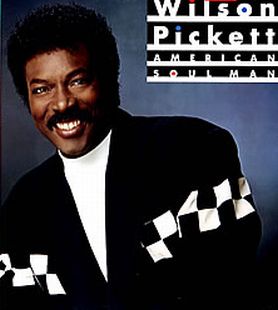 Ladies and gentlemen, I give you Wilson Pickett’s American Soul Man.
Right away, you can tell that the man on the cover is not the Wilson Pickett you remember — the man they called Wicked Pickett, whose sheer vocal ferocity was enough to make Teddy Pendergrass sound like John Denver. What’s with that sweater? And that glassy-eyed smile? And the Olan Mills backdrop? Why would Motown’s art department try to turn Wilson Pickett into Bill Cosby’s stunt double?
These are all valid questions. Sadly, they’re all swept away the instant you turn on American Soul Man, because a silly thing like an ugly album cover pales in comparison to a musical travesty this thoroughly misguided. For reasons I’ll never understand, former Zappa (and, um, Orleans) sideman Robert Martin was a heavy presence on the record, weighting down each song with a series of mannered, bloodless backing tracks devoid of soul, funk, or human rhythm. There are blues, yes, but only the ones you’ll be singing after you listen to it. It’s like someone trapped Wilson Pickett in a Richard Marx album.
And what’s even worse is that American Soul Man doesn’t have the common courtesy to put its worst tracks out in front. Most albums like this, where the label is trying to straitjacket an artist into a sound that doesn’t fit, open with their most desperate grabs for chart success. This one’s painfully sneaky, though — it starts off with the timid, watered-down Miami Vice funk of “Thing Called Love,” lulling you into thinking Motown is only going to neuter Pickett in exchange for a (hopefully fat) album advance, and then it busts out with the air-conditioned tropical breeze of the despicable “When Your Heart Speaks,” which I sincerely hope Pickett recorded when he was either high as a kite or at gunpoint.
Oh, and it gets worse. Wilson Pickett was never known as the guy you turned to when you wanted a tender ballad, so of course it stands to reason that American Soul Man also includes a pair of Casio jizz-coated slow jams, “Love Never Let Me Down” and “Don’t Turn Away,” both of which sound like something Billy Vera might have farted out in his sleep while working on the soundtrack for Blake Edwards’ Blind Date. Whether or not you know or care about Pickett’s splendid earlier work, these songs are offensive.
But not as offensive as the album’s worst track, a plodding update on “In the Midnight Hour” that swaps out the gritty soul of the original for the keyboard goop, fake horns, needlessly busy drum programming, and masturbatory guitar noodling of classic ’80s L.A. douche rock — and then has the nerve to pretend it’s a “live” performance. About the only thing you can say in its favor is that it didn’t come with a video starring Dan Aykroyd and John Candy, like the not-quite-as-dire “Land of 1000 Dances” remake that Pickett recorded for The Great Outdoors the following year.
American Soul Man never gets worse than “In the Midnight Hour” — few albums do — but it doesn’t really get any better, either, closing out with the embarrassing “Can’t Stop Now,” which sounds like something you might hear during one of the decade’s many terrible action movies. Fortunately, the song’s title didn’t prove prophetic, at least in the short term; perhaps recognizing there was no room for genuine soul in the marketplace, Pickett disappeared for over a decade, not resurfacing until 1999’s marvelous It’s Harder Now. He didn’t survive long enough to record a follow-up, but at least American Soul Man wasn’t Pickett’s closing musical statement, instead remaining a deservedly obscure footnote in a distinguished career. And I do mean obscure: Aside from a perfunctory Allmusic review, you won’t find much of anything about this album online. Even Pickett’s Wikipedia page does its best to skip over the album, only listing it in his discography and summing up his post-Atlantic output by saying “Pickett continued to record sporadically with several labels over the following decades, occasionally making the lower to mid-range of the R&B charts.”
As far as I can tell, Wilson Pickett’s ghost has been purchasing every available used CD copy of American Soul Man and destroying them with ectoplasmic hate vapors, but thanks to the intrepid efforts of Rob Smith and Matt Wardlaw, we — and by “we,” I mean “me and whoever else is stupid enough to download this shit” — have the whole sorry mess on mp3. Ladies and gentlmen, without further ado, I present the complete and unedited American Soul Man. You’re welcome.
Wilson Pickett – Thing Called Love
Wilson Pickett – When Your Heart Speaks
Wilson Pickett – Love Never Let Me Down
Wilson Pickett – Man of Value
Wilson Pickett – (I Wanna) Make Love to You
Wilson Pickett – In the Midnight Hour [Live]
Wilson Pickett – Don’t Turn Away
Wilson Pickett – Just Let Her Know
Wilson Pickett – Can’t Stop Now
![Reblog this post [with Zemanta]](http://img.zemanta.com/reblog_e.png?x-id=b36bc406-2114-4dd5-9d58-4f6a9db27714)


Comments