

This article is about something that never ceases to make me roll my eyes.
It’s the seemingly endless band names and song names with “cute”, “funny” or “anti-establishment” capitalization and spacing.
I’m sure without prompting that you can think of 5-10 examples I didn’t include. Lower-case, removing spaces, numbers inside words, special characters.
I can’t decide if I’m annoyed by the practice or simply bored by it.
The more important question is: Why do artists do this? What’s being gained here?
Do people think this makes them interesting? Are they sticking it to “the man” and “Big Grammar”?
Period.
Recently, I reviewed RAYE’s new album “THIS ALBUM MAY CONTAIN HOPE.” with all caps then extra period. The same for all of the songs, e.g. “I WILL OVERCOME.”
Writing that review made my AI-assisted spell-check and proofing tools overheat. Yes, it became a little tedious over the course of that article; but that’s just a mildly annoying writer’s problem.
Artists should have artistic reasons for their decisions. I’m not saying they need to be brilliant reasons, just reasons. “Wouldn’t it be cool if we called our album ‘lowERcase’?” is not a reason.
Maybe the first writers, artists, and musicians to trade on offbeat punctuation or capitalization were proving a point – and it was saying something. But now???
When There Was a Point
E.E. Cummings used lower case for effect in his poetry, then his publisher listed his name as “e.e. cummings” on a couple of titles against his wishes. Singer K.D. Lang preferred the lower case “k.d. lang” stating that she was a fan of “E.E. Cummings” who’s lower-case was a false premise – so, then we’re off to the imitative races.
Prince moved to a symbol for a reason – a dispute with his record company; and it was newsworthy for about two weeks as setups to bad comedian punchlines.
But the artists copying the artists who copied the artists who were copying those original artists are treading in some pretty tired waters.
Yes, copycats are a part of every art form:
- Faux Tarantino dialogue about hamburgers
- Delay pedals as shorthand for mood after U2 perfected it
- Auto-tune after T-Pain
- Found footage movies after Blair Witch Project
- Mockumentary interviews after Waiting for Guffman.
- Undisciplined meth-head run-on sentences after Jack Keruoac.
A wise man could have said, “Don’t borrow the artifact if you don’t understand the impulse that created it.”
Think Before You Misspell
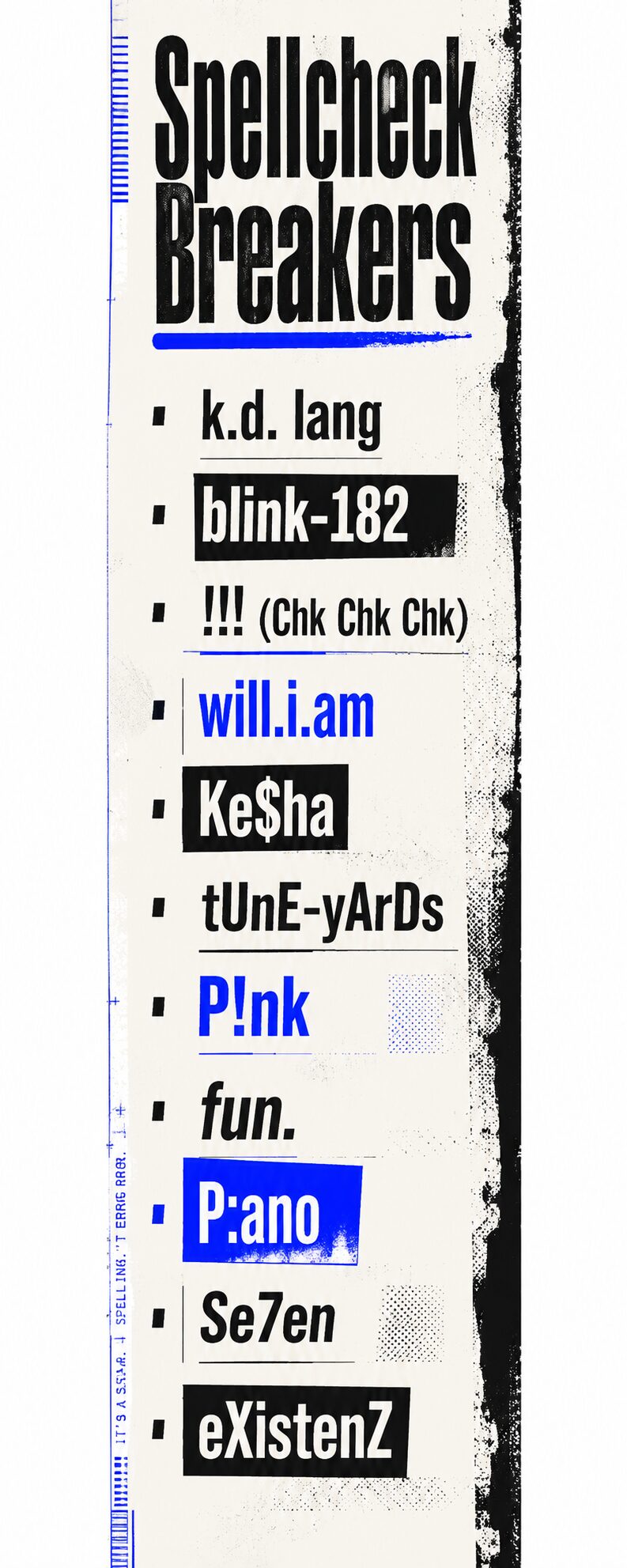
The practice of being unfettered by correct spelling or capitalization would be more convincing if half the industry weren’t doing the exact same thing.
And while I’m trying to give advice to bands and authors who are not reading this, the practice is a terrible unforced error in the modern marketplace. Making your artist’s name, album title, or songs unsearchable in lots of popular search algorithms can reduce fans’ odds of finding you. Hope it was worth it.
Who are these bands rebelling against? Apple Music? The Chicago Style Manual?
My Only Unusually Titled Experience
One of my favorite collaborators has been Spud Davenport in our musical project, Leaders In The Clubhouse. He was adamant that our song be titled ‘LawnChairs’ instead of ‘Lawn Chairs.’ I never completely understood the reasoning, but I also didn’t think it mattered much.
When reviewers occasionally wrote it as two words, I just couldn’t bring myself to care. If someone liked the song enough to mention it, that seemed like the important part.
My bigger artistic style regrets were swearing for little to no reason in a couple of early songs I recorded. Did that make us edgy? Or did it just make us go through a pointless hassle of putting an “Explicit Content” label on the record?
Conventional Can Be the Most Unconventional Move
The artists and thinkers I admire most often looked remarkably conventional on the surface.
Joseph Campbell and Tom Wolfe are heroes of mine, and partially because they proved the most revolutionary can do their thing under the cover of looking totally conventional. They didn’t need eccentric branding, or visual gimmicks to signal originality. The work did that for them.
I hate to sound like a defender of conventional thinking – and I’m not. I’m defending convention, not conventional thinking. The more buttoned-down types usually are the ones that last longer; normalcy is a Trojan horse for revolutionary art.
If somebody wants to write or record something outside of the mainstream, save it for the actual art instead of the punctuation.


Comments